
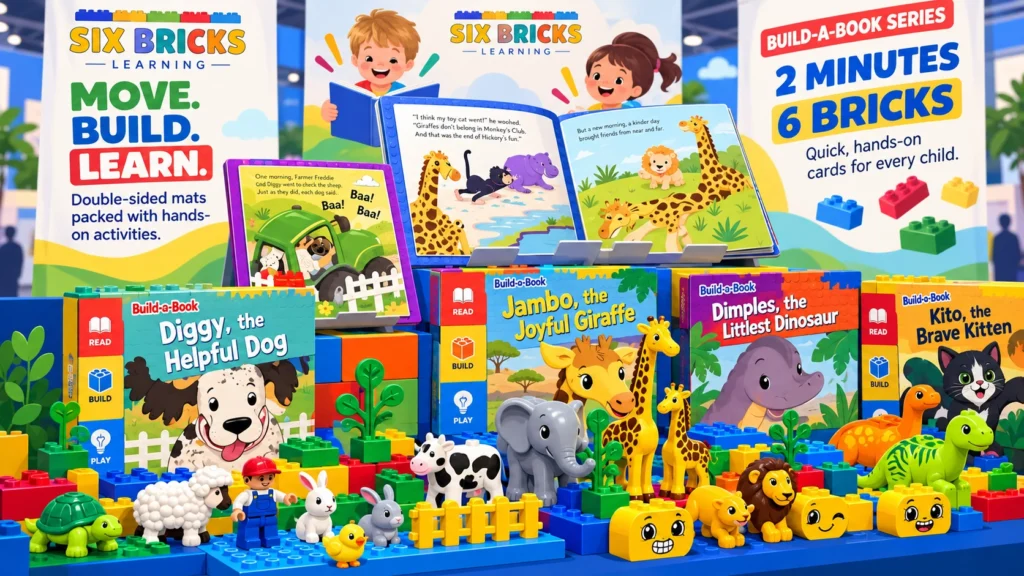
ECA Conference 2026: What Early Childhood Educators Told Us
Spend a day at an early childhood conference and you hear the same questions again and again. How do I make play intentional without adding more paperwork? What can I afford for a whole room? Will it work for my threes and my fives?
At the ECA Conference 2026 in Melbourne, we heard those questions at our booth many times. Early Childhood Australia’s National Conference ran from 30 September to 3 October at the Melbourne Convention and Exhibition Centre. Our founder, Dr Denise Meyerson, was there with the full Six Bricks Learning range: Build-a-Book kits, Play&Learn decks, Magnetic Bricks and Group Kits.
This post is more than a thank-you to everyone who stopped by. It shares what educators told us they need right now, which resources ran out first, and why. It also includes a short guide to help your center choose where to start with structured, brick-based play. These are first-hand observations from the booth.
Quick Overview
- Who is this for? Early childhood educators, educational leaders and center directors, whether or not you made it to Melbourne.
- What will you learn? The four needs educators raised most at ECA 2026, the three resources that sold out, and how to choose a starting point for your team.
- Key outcome: A clear idea of how short, structured brick play can support intentional teaching on a realistic budget.
What Is the ECA National Conference?
The ECA National Conference is Early Childhood Australia’s annual gathering for the education and care sector, and it is often described as the sector’s leading conference in Australia. It brings together educators, leaders, researchers and suppliers for keynotes, workshops and an exhibition hall.
The 2026 conference ran from 30 September to 3 October at the Melbourne Convention and Exhibition Centre. Its theme was “Holding the Past, Creating the Future.” Early Childhood Australia is the peak advocacy body for children under eight and their families, so the event attracts a wide mix of people: room leaders, center directors, pedagogical leaders and family day care educators.
Six Bricks Learning took a booth in the exhibition hall. Here’s what we brought:
- The Build-a-Book series: all five picture books, each with a brick kit so children build the story as it is read aloud.
- Play&Learn decks: activity card decks built around the “2 minutes, 6 bricks” idea.
- Magnetic Bricks: DUPLO®-style bricks with built-in magnets for vertical building.
- Group Kits, activity mats and course information for teams that want to go deeper.
What Did Early Childhood Educators Tell Us at ECA 2026?
Educators told us they want resources that cut prep time, make intentional teaching visible, stretch across age groups, and don’t strain the budget. These four themes came up often in conversations at the booth.
1. Less prep, more intentional teaching
Intentional teaching is one of the practices in Australia’s Early Years Learning Framework (EYLF V2.0). It means educators plan learning with purpose and can explain why they chose an experience. Many educators said they value intentional teaching but struggle to find planning time for it.
A short, structured activity solves part of that problem. When an activity card names the skill it builds, like focus, memory or sequencing, the purpose is already there. Educators can run it in minutes and point to it in their documentation.
2. Low cost per child
Budget was one of the most common themes. Centers want resources that serve a whole room, not one child at a time. A set of six bricks per child is a low-cost resource, and the same bricks support more than 100 activities.
3. One resource across age groups
Mixed-age rooms are common, and educators asked whether one resource can work for every age group. This is where Vygotsky’s Zone of Proximal Development is useful. Children grow most when they are gently stretched, with challenges just beyond what they can do alone. The same Six Bricks activity can be made simpler for a three-year-old and harder for a five-year-old.
4. Use the bricks you already have
Many centers already own DUPLO®-style bricks. Educators were glad to hear that Play&Learn decks and Six Bricks activities work with bricks already on their shelves. For many centers, this was the lowest-cost way to begin.
What Sold Out at Our Booth, and Why?
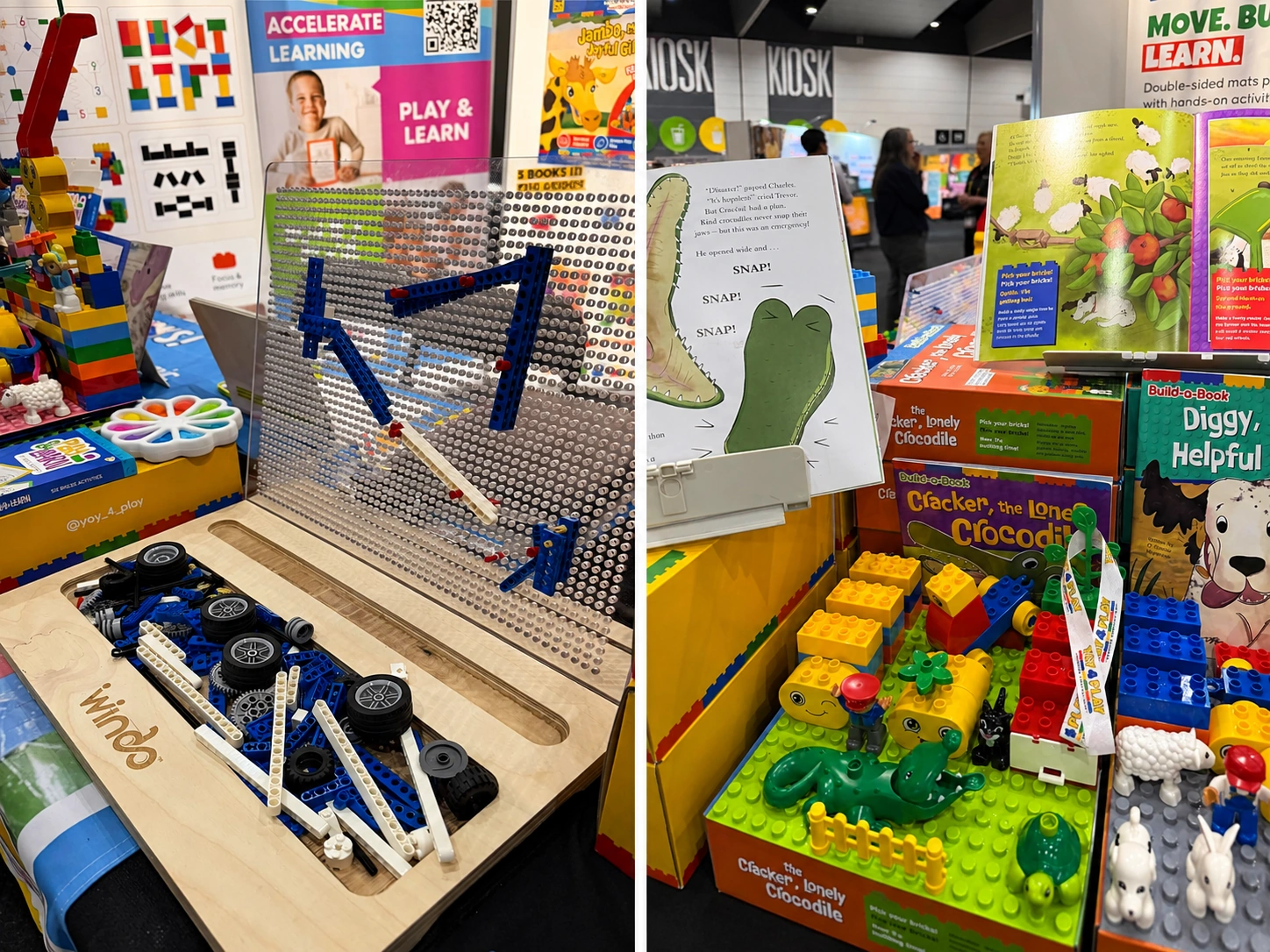
Three resources sold out at our ECA 2026 booth: the Dinosaur Build-a-Book, Magnetic Bricks and the Play&Learn decks. Each one fits at least one of the four needs above.
Dimples, the Littlest Dinosaur (Build-a-Book)
Dimples was our number one seller and sold out completely. Build-a-Book is a picture book series written by Dr Denise Meyerson. As each page is read, children “pick their bricks” and build a character, object or scene from the story. The Dimples kit includes the picture book, a base plate, building bricks, three emotion emoji pieces and dinosaur pieces, including a T-Rex, a Pterosaur, a Triceratops and little Dimples.
Build-a-Book supports language and vocabulary, listening and comprehension, and sequencing and retelling. The series has five titles:
- Dimples, the Littlest Dinosaur
- Jambo, the Joyful Giraffe
- Kito, the Bravest Kitten
- Diggy, the Helpful Dog
- Cracker, the Lonely Crocodile
Build-a-Book is used in more than 120 early learning centers across Australia.
Magnetic Bricks
Magnetic Bricks were the educators’ favorite add-on. They are DUPLO®-style bricks with built-in magnets, so children can build vertically on whiteboards and metal trays. Magnetic Bricks give the bricks centers already own a new dimension and add another layer of spatial and sensory discovery.
Play&Learn decks
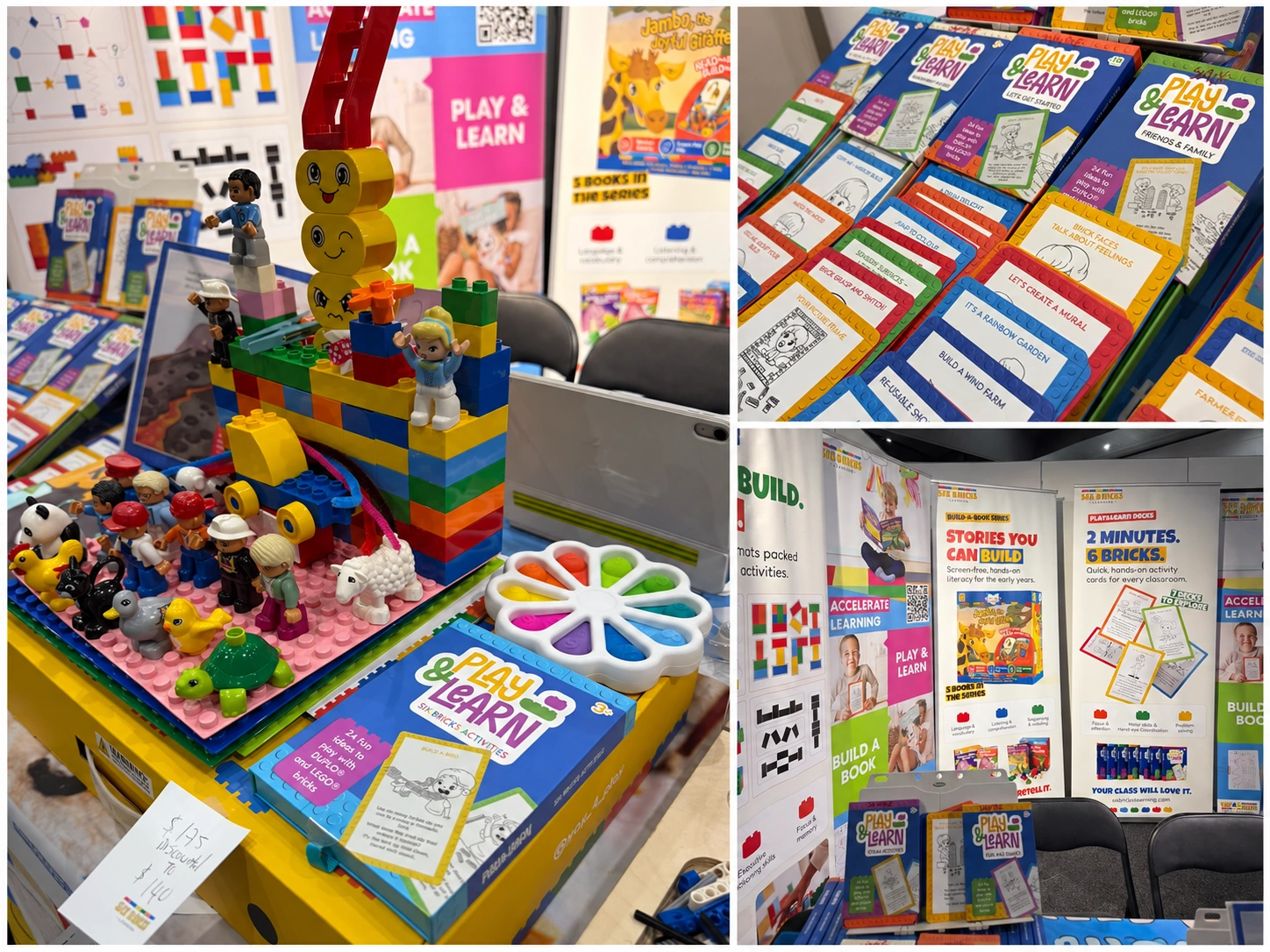
The Play&Learn decks sold out too. Each deck is a set of activity cards that turn a few minutes of brick play into a focused learning experience. Titles include Let’s Get Started, Fun and Games, STEAM Activities and Neurodiversity Builders. Educators liked the simple promise: pull a card, set up the play, and start teaching with purpose in minutes.
Behind the booth
Six Bricks Learning at ECA Melbourne 2026
What This Looks Like in a Mixed-Age Room: A Classroom Snapshot
A single Build-a-Book session can engage three-year-olds and five-year-olds at the same time, each at their own level. Here’s how that might look.
Imagine a mixed-age room on a Tuesday morning. The educator gathers six children on the mat and opens Dimples, the Littlest Dinosaur. She reads a page, then pauses. “Pick your bricks!” The children choose bricks and build the swamp from the story.
The youngest children match colors and stack bricks with help. They practice fine motor skills and listening. The older children build from memory and add detail, then retell what happened so far. That retelling draws on working memory and sequencing, which are core executive function skills.
The session takes about ten minutes. Afterward, the educator jots a short note for her documentation: the story, the skills practiced, and one observation per child. The play was joyful and hands-on, and it was planned with purpose. That combination is what intentional teaching looks like in practice.
Where Should Your Center Start? A Quick Decision Guide
Most centers start with whichever need is strongest: a lower-cost first step, early literacy, building variety, or whole-team confidence. Use this table to find your starting point.
| If you want to… | Start with | Why it fits | Price (AUD) |
|---|---|---|---|
| Try Six Bricks with bricks you already own | A Play&Learn deck | Quick activity cards, little prep | $35 per deck |
| Build early literacy through play | A Build-a-Book kit | Story plus guided build, with bricks included | $85 per kit |
| Add a new building dimension | Magnetic Bricks | Vertical, magnetic building on boards and trays | $75 |
| Run small-group sessions | Small Group Kit | Bricks, grids, emotion bricks, people and animals for up to 4 children | $175 |
| Bring structured play to a whole room | Large Group Kit | Classroom-scale kit for up to 16 children | $475 |
| Build team confidence | Online courses or Accreditation | Self-paced, practical PD | $95 per course · $250 accreditation |
Prices as listed on sixbrickslearning.com in October 2026.
A few tips for sharing conference ideas with your team:
- Pick one routine. Choose a single two-minute activity and run it at the same time every day for two weeks.
- Name the skill. Say out loud which skill the activity builds, such as focus, memory or sequencing.
- Document lightly. Add one line per session to your planning notes and link it to an EYLF outcome.
- Review together. After two weeks, ask your team what changed and decide what to add next.
Key Takeaways
- Educators at ECA 2026 asked for resources that reduce prep, make intentional teaching visible, work across ages, and fit tight budgets.
- Short, structured brick activities support executive function skills such as working memory and focus in just a few minutes.
- The Dinosaur Build-a-Book, Magnetic Bricks and Play&Learn decks sold out at our booth.
- One brick-based activity can be scaffolded up or down, which makes it a good fit for mixed-age rooms.
- Centers can start small with bricks they already own and build up to Group Kits and team training.
FAQ
When and where was the ECA Conference 2026?
What is Build-a-Book from Six Bricks Learning?
Can I use Six Bricks activities with the DUPLO® bricks my center already has?
How can play-based learning count as intentional teaching?
Do educators need training to use Six Bricks?
Missed Us in Melbourne? Bring the Booth to Your Center
Explore the Build-a-Book series, Play&Learn decks and Magnetic Bricks, or start with a self-paced course from $95. If you visited our booth, check your inbox for a thank-you offer from the team.
Explore the Collection