

ADHD Awareness Month: Structured Play That Supports Attention and Regulation
October is ADHD Awareness Month. It’s a good moment to ask one question. What actually helps a child with ADHD settle, focus, and feel successful? That question comes up in classrooms and living rooms alike. For many families and educators, the honest answer is “it depends on the day.” After all, attention and impulse control can shift from hour to hour, let alone week to week.
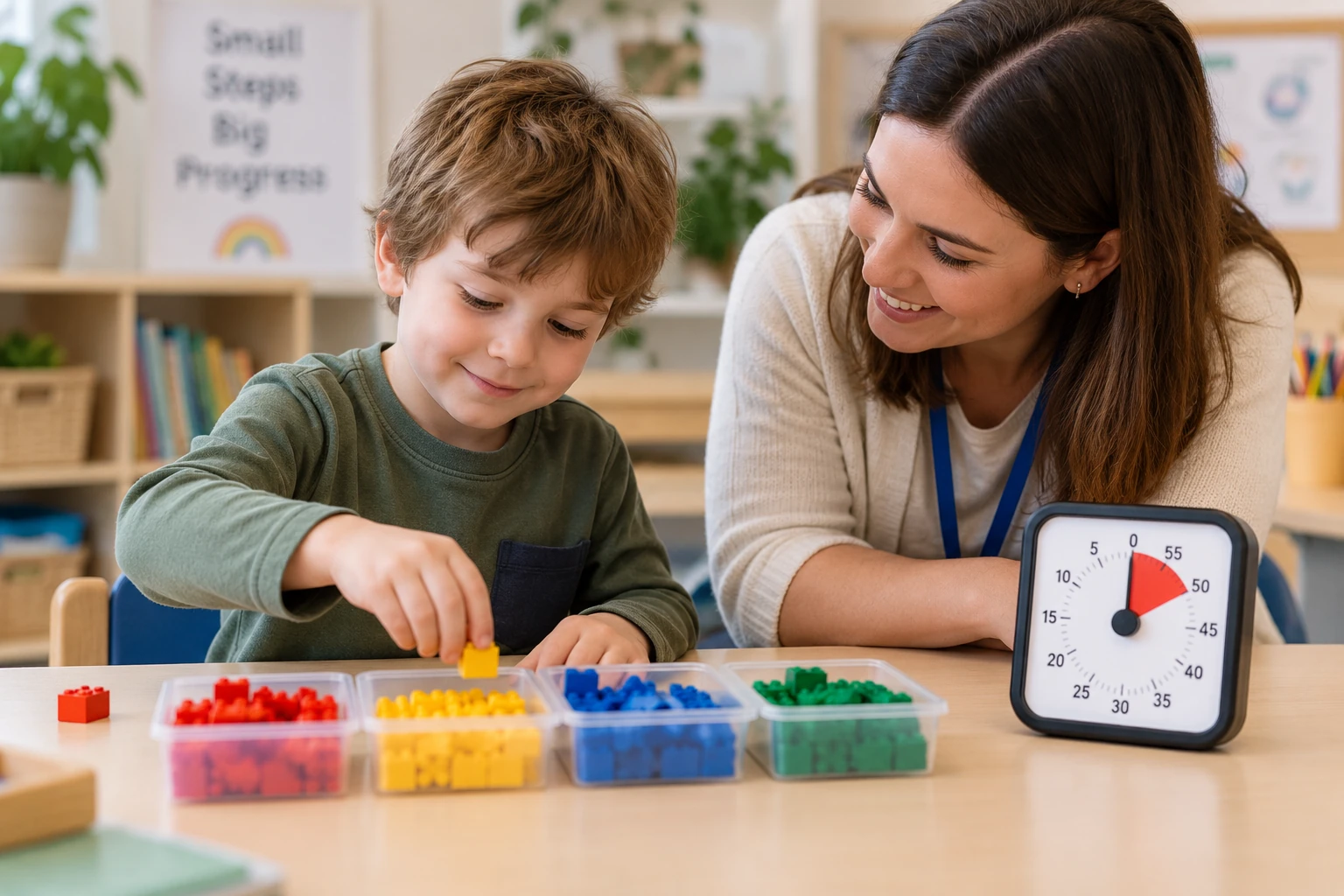
So what actually helps? Not a single trick, but a way of structuring time. Short bursts of activity work well. So do predictable routines and clear, simple rules. These rules don’t ask a child to sit still and quiet for long stretches. This is exactly the territory Six Bricks Learning’s approach was built for. Our activities are brief, hands-on, and multi-sensory. Most fit into two to five minutes. None require a child to read, write, or stay seated to take part.
This piece is a practical starting point for ADHD Awareness Month. It covers what structured play can realistically offer a child with ADHD, and what it can’t replace. You’ll also find a few simple strategies to try this week — at school or at home.
Quick Overview
- Who is this for? Early childhood and primary educators, learning support specialists, and parents of children with ADHD.
- What will you learn? Why short, structured, multi-sensory activities suit attention and self-regulation needs — plus practical ways to build them into a routine.
- Key takeaway: A small set of ready-to-use strategies for ADHD Awareness Month. These are meant to sit alongside — never replace — any professional or medical support a child is receiving.
What Is ADHD, and Why Does Activity Structure Matter?
ADHD (Attention-Deficit/Hyperactivity Disorder) is a neurodevelopmental profile. It affects attention regulation, impulse control, and activity level. However, the structure of a task often matters just as much as its content. That structure includes length, predictability, and sensory format. All of these shape how well a child with ADHD can engage.
Children with ADHD are not a single, uniform group. Attention and self-regulation needs vary widely from child to child. In fact, some children experience both ADHD and other neurodevelopmental differences together. So what helps, across all this variation? Task design that doesn’t depend on long, unbroken focus. That means short activities, clear start and end points, and a hands-on element. This gives restless energy somewhere useful to go.
This is not a clinical framing. Six Bricks Learning is a learning tool, not a therapeutic or diagnostic service, and this piece is not medical guidance. Instead, families and educators should keep working with the professionals already involved in that child’s care. What follows is simply about classroom- and home-friendly play strategies — ones that can sit alongside that support.
Why Short, Structured Activities Tend to Work Well
Short, clearly bounded activities ask less of sustained attention. As a result, they make it easier for a child with ADHD to start, stay engaged, and finish successfully.
A worksheet that takes fifteen quiet minutes asks a lot of a child whose attention shifts every few minutes. By contrast, a two-to-five-minute hands-on activity asks far less of that system, while still building the same skill. This is part of why brief “brain break” activities are common in ADHD-friendly classrooms. They respect how attention actually works for these children. They don’t ask children to override it through effort alone.
There is also a growing body of research on movement and attention. Active, movement-based breaks are widely studied as a way to support focus and executive function — including for children with ADHD. This piece only touches on that research in general terms. For a deeper look, see our companion piece on playful movement and school readiness. The takeaway here is simple: brief, physical, structured activities are a well-supported strategy, not a one-off trick.
Working memory and inhibitory control are two of the three core executive functions. Both are frequently areas of difference for children with ADHD. Short, repeated, low-stakes practice helps here — especially when it’s delivered through play rather than pressure. This gives children a chance to build capacity, without the activity itself becoming a source of frustration.
Predictability and Transitions: The Underrated Support
Predictable routines reduce the number of decisions and surprises a child has to manage at once. As a result, more attention is free for the actual task, rather than the uncertainty around it.
Transitions — between activities, subjects, or environments — are often the hardest moment in a child’s day. A consistent, simple routine can help. Think the same signal, the same short activity, every time a transition happens. This removes one layer of unpredictability from an already demanding moment.
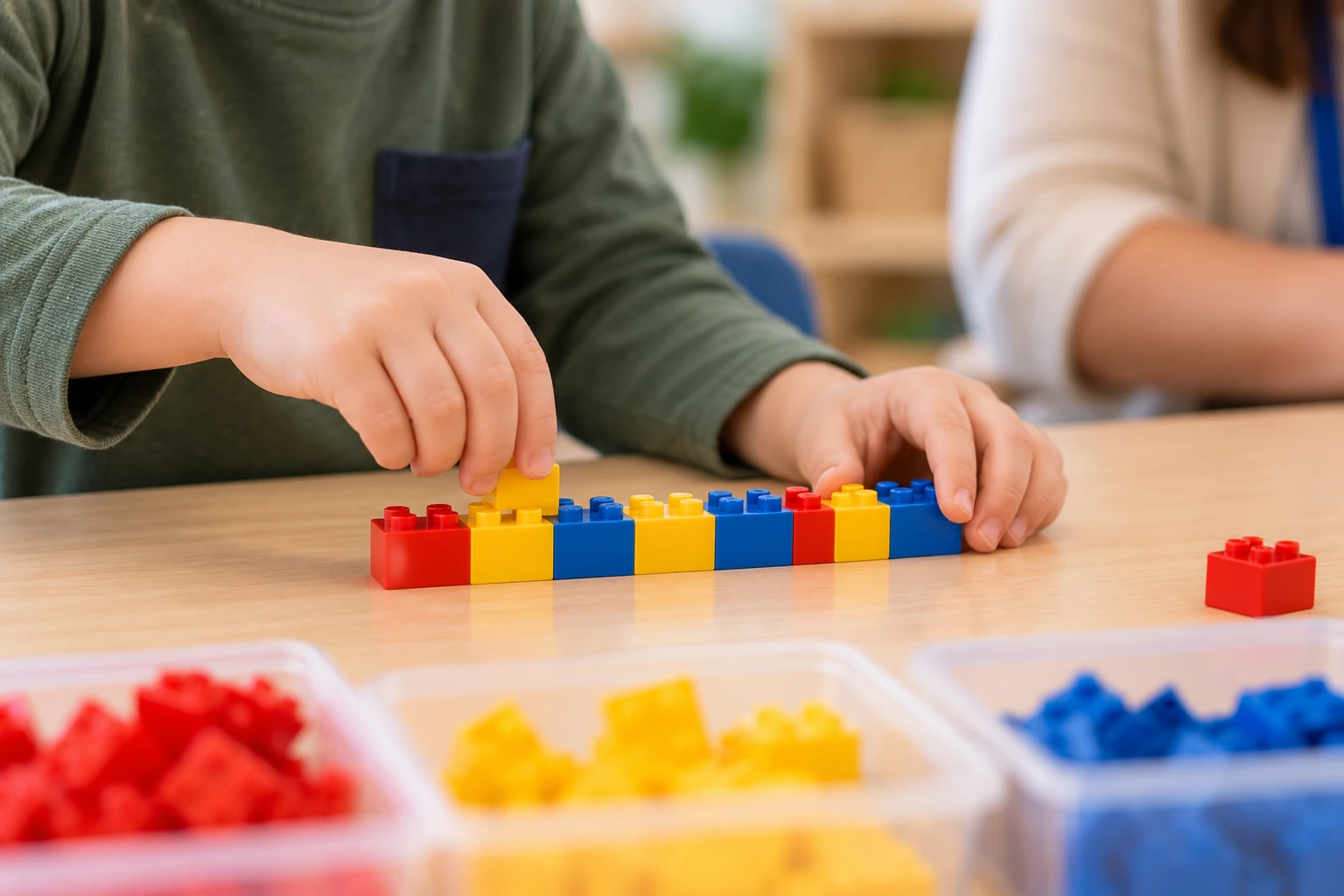
This is where a small, repeatable ritual can do more than a longer, novel activity. Take a two-minute brick-sorting or pattern-building routine, used the same way at every transition. Over time, it becomes something the child can predict and lean on. It’s not something new to figure out on top of everything else.
What This Looks Like in Practice: A Classroom Scenario
Imagine a Year 1 classroom moving from group discussion into independent reading time. For one student with ADHD, this transition has historically been rocky. Instead of “settle down and read,” the educator uses a 90-second brick routine at every transition. The task: build a pattern with three colours, in any order, then place the bricks back in the tray.
There’s no right answer here, and no reading required. The activity has a clear beginning and end. The student completes it, and hands stay busy. As a result, the shift into quiet reading happens with noticeably less friction than a direct instruction alone would produce. The routine isn’t solving ADHD. Instead, it gives the transition a predictable, low-demand bridge — often exactly what’s needed.
Strategies to Try This ADHD Awareness Month
A short checklist can help you build attention-friendly structure into an existing routine, at school or at home:
- Shrink the activity, not the goal. Break a longer task into two-to-five-minute segments with a clear end point — instead of one long stretch of focus.
- Use the same transition ritual every time. A short, repeatable activity at predictable moments (start of day, between subjects, before pack-up) reduces the uncertainty transitions bring.
- Give restless energy a job. Hands-on, tactile activities let physical energy support the task instead of competing with it.
- Keep instructions to one step at a time. Multi-step instructions are harder to hold in working memory; a single clear step reduces the load.
- Use emotion or feeling check-ins before and after. A quick, wordless signal — like choosing an emotion brick — shows how a child is feeling. This can flag when a break or adjustment is needed, before frustration builds.
- Celebrate the attempt, not just the outcome. Success for a child with ADHD often looks like “started and finished,” not “produced a perfect result.” Naming that clearly helps build confidence.
| Common classroom default | ADHD-friendly adjustment |
|---|---|
| One long, unbroken task | Several short, clearly bounded segments |
| Multi-step verbal instructions | One step at a time, repeated as needed |
| Unstructured transition time | A short, predictable transition ritual |
| Sit-still, quiet-hands expectation | A hands-on element built into the task |
| Success measured by finished product | Success measured by engagement and completion |
Key Takeaways
- October is ADHD Awareness Month — a useful moment to review whether classroom and home routines are structured in attention-friendly ways.
- ADHD affects attention regulation, impulse control, and activity level differently for every child. So strategies should be adapted, not applied as a single formula.
- Short, clearly bounded, hands-on activities ask less of sustained attention than longer, quieter tasks. Even so, they still build the same underlying skills.
- Predictable transition routines reduce the number of surprises a child has to manage, freeing up attention for the task itself.
- Working memory and inhibitory control are two core executive functions. Both are common areas of difference for children with ADHD, and both can be gently practised through short, low-stakes play.
- Structured play is a helpful complement. However, it’s never a substitute for the medical or therapeutic support a child with ADHD may be receiving.
FAQ
What classroom strategies help children with ADHD focus?
Can play-based activities help children with ADHD at home?
Is Six Bricks a treatment for ADHD?
Why do short activities work better than long ones for children with ADHD?
How can I make classroom transitions easier for a child with ADHD?
Build Attention-Friendly Routines Into Your Week
Looking for short, structured activities that fit naturally into a busy classroom or home routine? Explore our Group Kits, including emotion bricks for regulation support. Or book a free introductory webinar to see the Six Bricks method in action.
Explore Group Kits