

Playful Movement and School Readiness: What New Research Shows
By 10am, most early childhood educators have already run a few rounds of “everybody up, everybody moving.” It’s not on the lesson plan. A room full of five-year-olds simply can’t sit still for long, so movement becomes the plan anyway.
But a sharper question is starting to matter just as much. Does how children move count for as much as whether they move at all? That’s the real question behind playful movement and school readiness. A study published in July 2026, in the peer-reviewed journal Behavioral Sciences, took that question into an actual preschool classroom.
Researchers ran an eight-week program. They built specific cognitive challenges — remembering a rule, holding back an impulse, planning a next step — directly into movement games. Then they compared the results to a standard physical education group.
The findings are still early and small in scale. Even so, they point in a direction most educators already sense: a short, structured, hands-on activity often settles a room faster than a worksheet ever could. This matters for Six Bricks Learning too, because our activities build on exactly this pairing — brief, physical, cognitively demanding play, delivered in minutes rather than hours. So here’s what the study actually found, what to treat cautiously, and what a movement-based brain break for executive function can look like in your own classroom this week.
Quick Overview
- Who is this for? Early childhood and K–2 educators, movement/PE specialists, and parents looking for active alternatives to screen-based brain breaks.
- What will you learn? What a new 2026 study found, why movement and cognitive challenge seem to work better together, and how to build your own short movement-based brain break.
- Key takeaway: A research-informed way to combine movement and executive function practice in five minutes or less, using materials already in the classroom.
What Is “Cognitively Enriched” Movement, and Why Does It Matter for Executive Function?
Cognitively enriched movement means a physical activity that also demands a specific mental skill. Think remembering a rule, stopping an impulse, or following a multi-step plan — all while the body keeps moving.
A regular game of tag asks children to run and dodge. A cognitively enriched version adds one more layer. Children might freeze on a signal, remember which colour means “stop,” or follow a changing sequence of moves. The physical demand stays the same. Adults simply add the cognitive layer on purpose.
This distinction matters. Executive function covers working memory, cognitive flexibility, and inhibitory control. Together, these are among the strongest predictors of school readiness. Research consistently suggests children build these skills best through repeated, active practice, not passive instruction. Plain movement is good for children’s bodies. Movement paired with a cognitive challenge seems to give executive function itself a workout.
Playful Movement and School Readiness: What the New 2026 Study Found
A small preschool study found something striking. Children who did eight weeks of cognitively enriched movement games showed larger gains in inhibitory control and planning than children who did standard PE. But some of the study’s more dramatic figures deserve caution, not a headline.
Inside the Study
Researchers worked with 48 five-year-olds. They split the children into an intervention group and a control group. Over eight weeks, the intervention group played movement games three times a week, an hour each time. Each session embedded response inhibition, working memory, and planning tasks directly into the play. Meanwhile, the control group did standard PE for the same amount of time.
The results favoured the intervention group clearly. On a standard “stop-and-go” test of inhibitory control, their errors dropped substantially more than the control group’s did. A separate planning task also favoured the intervention group by a wide margin.
Reading the Results With Caution
The study also reported large gains in early maths, language, and social competence for the intervention group. This is exactly where caution matters most. The authors themselves flagged some of their own effects — particularly around visuospatial memory — as unusually large for a study this size. They described these results as exploratory, not confirmed.
Only 48 children took part, at one location, with uneven group sizes. So treat this as an early, promising signal — not proof that any single program produces these exact results. No clinical trial has tested Six Bricks itself this way, so none of these figures make a claim about Six Bricks outcomes specifically.
Why Movement and Cognitive Challenge Seem to Work Better Together
The idea that body and mind learn together isn’t new. Embodied cognition theory holds that children build stronger understanding when they physically handle, move, and manipulate their environment. Passive learning simply doesn’t do the same work.
Consider the difference directly. Ask a child to remember a sequence and then perform it, and they rehearse working memory in a genuinely demanding way. Ask them only to repeat a movement they’ve already seen, and the mental demand drops sharply.
This is also why a brain break that genuinely challenges thinking works differently from one that simply burns energy. Both matter, of course. But only one does double duty: it burns off energy while also exercising working memory, cognitive flexibility, and inhibitory control — the exact skills research links most strongly to later academic success.
What This Looks Like in a Six Bricks Classroom
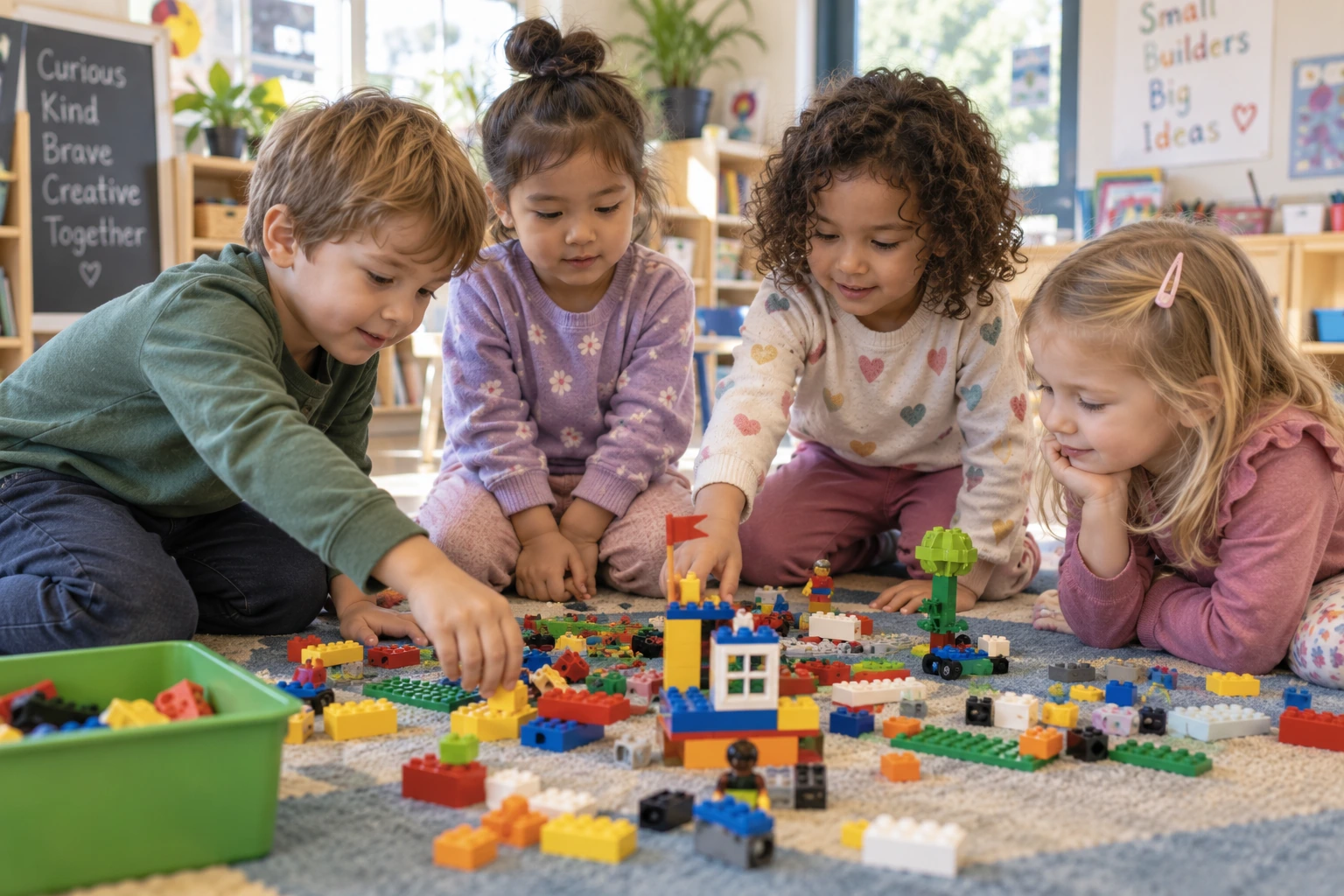
Picture a Pre-K classroom mid-morning. The teacher lays six bricks in a row on the floor mat. Then she calls out a simple rule: “When I say a colour, run and touch it — but if I say ‘red,’ freeze instead.”
Children move, laugh, and clearly enjoy themselves. At the same time, they’re doing three things at once. They hold the rule in mind — that’s working memory. They resist the urge to run on “red” — that’s inhibitory control. And they adjust quickly when the called colour changes — that’s cognitive flexibility.
The whole activity takes about four minutes, using nothing but the six bricks already in the room. No child stands out, and none needs to read or write to take part. That makes it just as usable for a child with limited English or an emerging reader as for anyone else in the group. In short, this is the same idea the July 2026 study points to: movement does more work when a genuine cognitive rule rides along with it.

Building Your Own Movement-Based Brain Break
A structured, cognitively enriched brain break doesn’t need a research budget to run. It just needs three ingredients:
- Pick one executive function skill to target. Don’t try to build working memory, inhibitory control, and cognitive flexibility all at once. Choose one, and build the activity around it.
- Add a rule that requires real thinking, not just movement. A “stop on this signal” rule targets inhibitory control. A “remember this sequence” rule targets working memory. And a “the rule just changed” twist targets cognitive flexibility.
- Keep it short and repeatable. Two to five minutes is enough. The value comes from repetition in short bursts, not one long session.
| Plain movement break | Cognitively enriched movement break |
|---|---|
| Burns energy, resets attention | Burns energy and practises a specific executive function skill |
| No rule to track or remember | A simple rule children must hold in mind |
| Good as a transition tool | Good as a transition tool and a skill-building routine |
| Any physical activity works | Needs one deliberate cognitive layer added |
Neither approach is wrong. Sometimes children just need to move. But when there’s a moment to add one small rule, research suggests that’s where the extra developmental value sits.
Key Takeaways
- A new 2026 study found that preschoolers who did eight weeks of cognitively enriched movement games gained more in inhibitory control and planning than a standard PE group. It’s a promising but small, single-site, preliminary finding.
- The study’s own authors flagged some results — especially around visuospatial memory and certain competence gains — as unusually large. They called for replication in bigger, more rigorous trials.
- “Cognitively enriched” simply means adding one clear mental rule — remember, stop, adapt — to an otherwise ordinary movement game.
- Embodied cognition research supports a simple idea: physically handling and moving through a task builds stronger understanding than passive instruction alone.
- A movement-based brain break needs only one targeted executive function skill, a simple rule, and two to five minutes. That’s enough to make it worth repeating daily.
- No specific outcome from this study is a claim about Six Bricks. These activities align with the same direction of research — they don’t replicate the study itself.
FAQ
What is a cognitively enriched movement activity for preschoolers?
What does the research say about movement and executive function in young children?
How can I add executive function practice to classroom movement breaks?
Do movement-based brain breaks work for children who don’t yet read or speak much English?
How does Six Bricks build executive function through movement?
Bring Movement and Executive Function Together
Want a ready-made way to combine the two in your classroom? Explore our Group Kits for movement-friendly brain-break activities, or book a free introductory webinar to see a live executive-function routine in action.
Explore Group Kits