
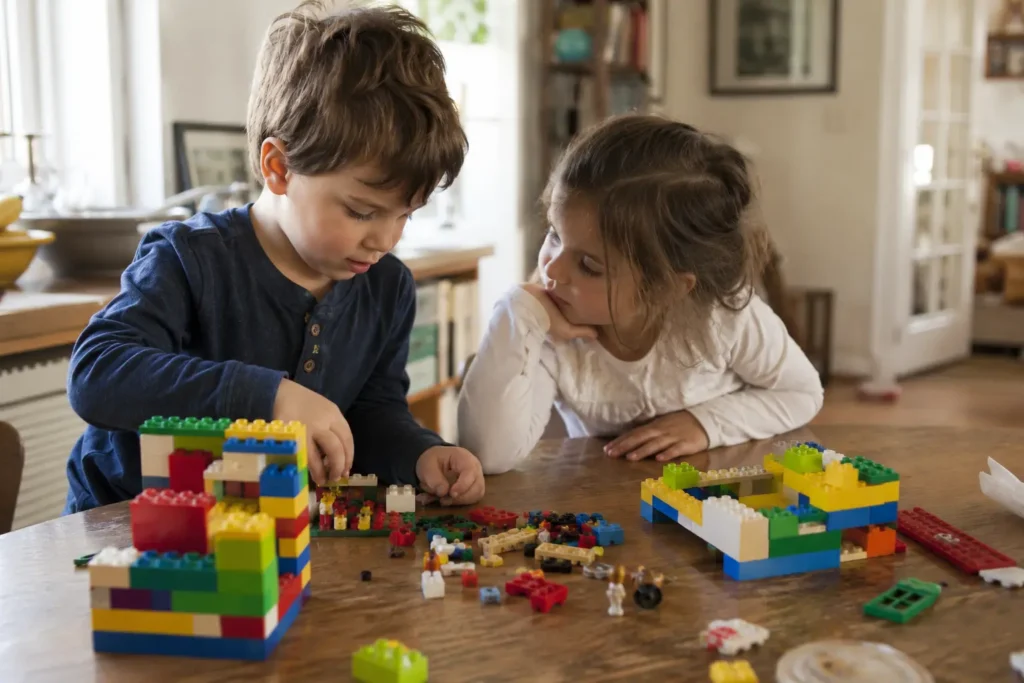
Brain Break Activities for the Classroom: A 2026 K–2 Guide
It’s 1:47 on a Wednesday afternoon. The Year 1 class has just come back from lunch, and the room is louder than the lesson plan allowed for. Two children are still finishing a conversation from the playground. One is under a table. Nobody is ready for a numeracy block — but the timetable says it starts in three minutes.
Every educator knows this moment. Attention has scattered, bodies are restless, and meanwhile the next task needs a kind of focus the class simply doesn’t have yet. “Settle down, everyone” rarely fixes it, because the problem isn’t behaviour. Instead, it’s regulation.
This is precisely where brain break activities for the classroom earn their place. In short, a brain break is a deliberate pause that helps children reset attention before the next demand. When it’s structured rather than free-form, however, it does something more: it gives children repeated practice in the exact skills the next lesson is about to ask for.
Six Bricks routines are built for this window. In fact, six DUPLO®-style bricks, two to five minutes, and one clear instruction are enough to move a class from scattered to settled. Below, this guide covers what makes a brain break work, five activities you can run tomorrow, how to choose the right one for the moment, and finally, what you actually need to run them across a full classroom.
Quick Overview
- Who is this for? K–2 teachers, early childhood educators, and centre directors in early learning centres and Pre-K classrooms.
- What will you learn? Five structured brain break activities, a decision guide for choosing between them, and the resources needed to run them at class scale.
- Key takeaway: A structured five-minute reset does two jobs at once — it settles the room and builds working memory, cognitive flexibility, and inhibitory control.
What Is a Brain Break — and Why Do K–2 Classrooms Need One?
A brain break is a short, structured pause — usually two to five minutes — that interrupts sustained attention so children can reset before the next task.
Young children are not built for long stretches of undivided focus. As a result, the transitions between activities become the highest-friction points of the school day. Nonetheless, developmental research broadly supports the view that short, predictable routines help children build regulatory capacity, because the pattern itself becomes familiar. In other words, the child isn’t just calming down once. Rather, they’re rehearsing how to calm down.
Signs a class needs a break, not a redirection
- Firstly, instructions need repeating more than twice
- In addition, children are moving without purpose, or have gone unusually still and flat
- Meanwhile, off-task talking spreads quickly from one table to another
- Often, the class has just come in from lunch, sport, or an assembly
- Above all, you’re about to start something cognitively demanding — maths, writing, or a new concept
Why Structured Brain Breaks Work Better Than a Free-for-All
A structured break returns a class to focus faster than an unstructured one, chiefly because it gives children a defined start and a defined end instead of an open field.
Free play has enormous value — but it isn’t a transition tool. Once a room is unstructured, for instance, bringing it back becomes a second job. By contrast, a structured break borrows the energy of play while keeping the frame intact.
| Unstructured break | Structured Six Bricks break | |
|---|---|---|
| What children do | Choose their own activity | Follow one clear, shared instruction |
| Duration | Tends to expand | Fixed: 2–5 minutes |
| Coming back | Requires a second settling | Built into the activity’s ending |
| Skills practised | Varies by child | Working memory, cognitive flexibility, inhibitory control |
| Educator effort | High during and after | Low — the routine carries it |
Ultimately, the difference matters because of what sits underneath. Executive function — working memory, cognitive flexibility, and inhibitory control — is among the strongest predictors of school readiness, and moreover, research consistently shows these skills are highly trainable in early childhood. Therefore, a structured break is a rep. An unstructured one usually isn’t.
Five Brain Break Activities for the Classroom Using Six Bricks
The five below are simple, whole-class-friendly examples in the Six Bricks style. Notably, they use nothing but the standard six-brick set, one per child. Beyond these, the online learning portal included with the kits documents 100+ activities in full, with video demonstrations.
Routines that build memory and focus
- Colour call (1–2 minutes — working memory)
First, call out a colour sequence — “red, blue, yellow” — and children stack their bricks to match from memory. Then, as the term progresses, extend it by adding a fourth and fifth colour. - Build what I build (3–4 minutes — visual-spatial reasoning)
Build a small structure at the front, hold it up for five seconds, then hide it. Next, children reproduce it from memory. Because spatial reasoning is foundational for mathematical thinking, this makes a strong lead-in to a numeracy block.
Routines that build self-regulation
- Freeze stack (2–3 minutes — inhibitory control)
Children stack bricks while music plays and freeze the instant it stops, hands off the tower. Indeed, stopping mid-action is precisely the skill that inhibitory control describes. - Change the rule (3–5 minutes — cognitive flexibility)
Give an instruction — “tallest tower” — let children start, then change it mid-task: “now make it as flat as you can.” Ultimately, the value sits in the switch, not the build. - Feelings check-in (2–3 minutes — emotional literacy)
Using the emotions bricks, each child places the brick that matches how they’re arriving. Notably, no explanation is required. As a result, it gives low-verbal and quieter children a way to communicate without speaking.
What This Looks Like in a Real Classroom
Imagine that same Year 1 room at 1:47. The teacher doesn’t raise her voice. She taps a rhythm on the desk — the class knows it — and children move to their spots, where a set of six bricks already sits.
“Red, blue, yellow, green.” Sixteen children build. Some check with a neighbour. One child who rarely speaks in group time builds first and grins.
Then, at 1:52, the bricks go back in the tub, and the class opens their maths books. Altogether, the transition cost about five minutes, and in return it bought back a numeracy block that would otherwise have started in noise. Furthermore, over a term, that same routine has been run roughly sixty times — sixty short rehearsals in holding information, waiting, and switching tasks on cue.
How to Choose the Right Brain Break for the Moment
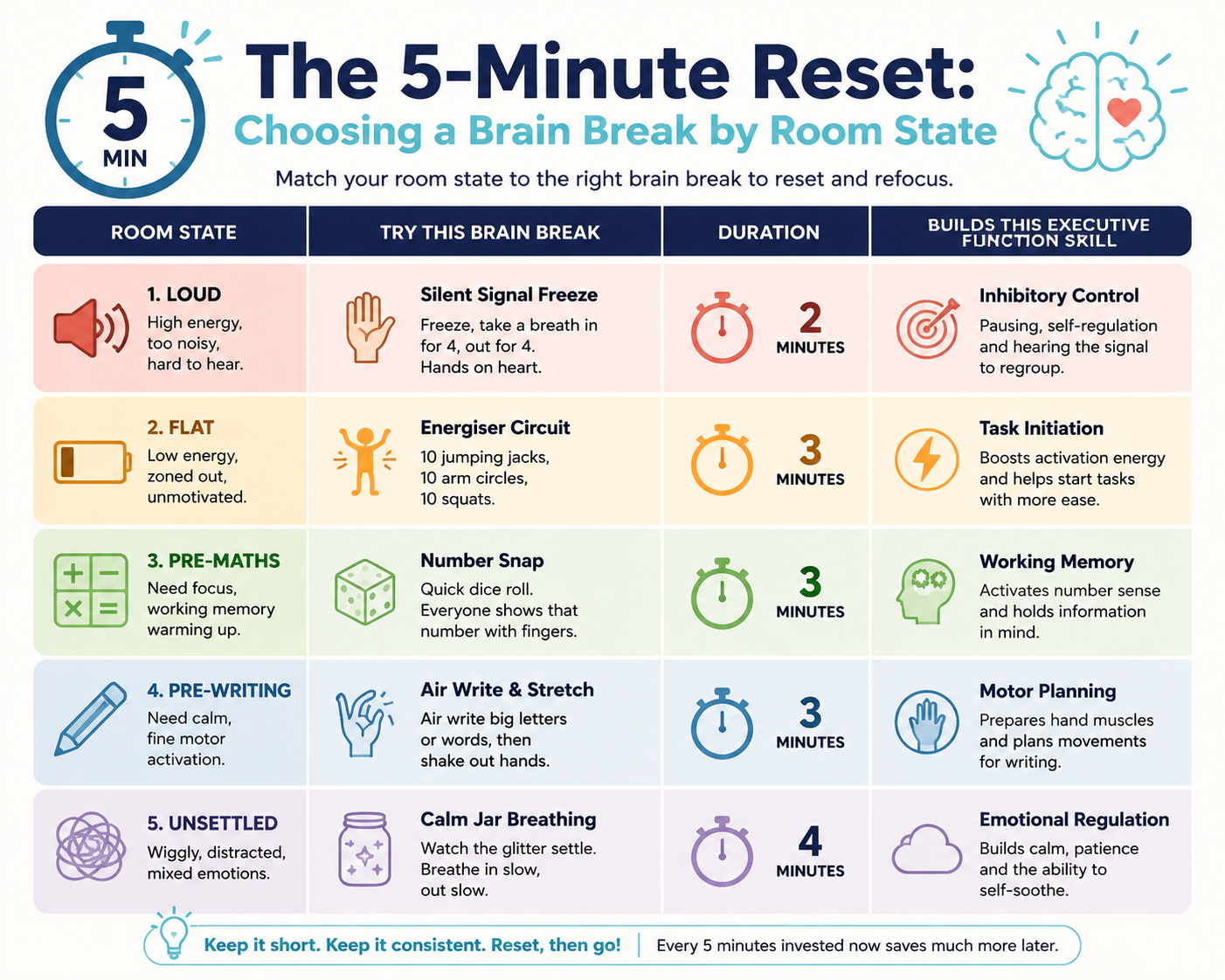
In practice, match the activity to the state of the room, not the position in your plan. For example:
- Room is over-aroused, loud, physically restless → Freeze stack. Movement first, then a hard stop.
- Room is flat, sluggish, post-lunch heavy → Colour call. Fast, verbal, low physical demand.
- You’re heading into maths or a spatial task → Build what I build. The break becomes the warm-up.
- You’re heading into writing or task-switching work → Change the rule. Related: building computational thinking without screens.
- Something happened — a conflict, an unsettling morning → Feelings check-in. Name it before moving on.
- You have 90 seconds, not five minutes → Colour call with a three-colour sequence, one round.
Making the choice inclusive
Finally, a note on inclusive practice: these activities are multi-sensory, predictable, and require little language, which in turn makes them accessible to a wide range of learners by design — not as an adaptation bolted on afterwards. As a result, children who process visually, who need movement, or who use few words all have a genuine way in. Similarly, the same case holds for why hands-on learning still matters in a digital age.
What You Need to Run Brain Breaks Across a Whole Class
Above all, one rule matters more than any other: every child needs their own set of six bricks. Otherwise, if children share or wait for a turn, the activity stops being a reset and instead becomes a queue.
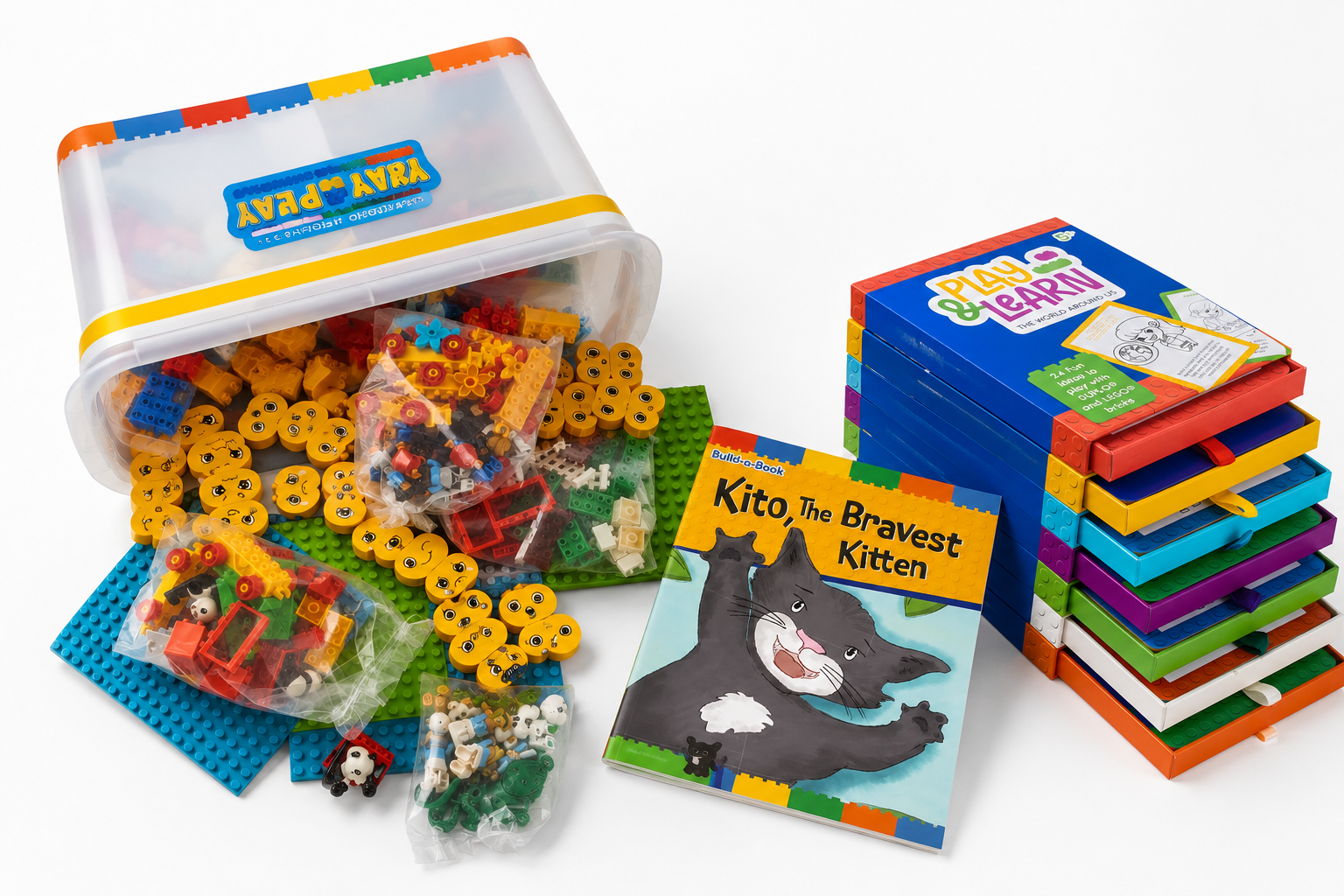
What’s in the Large Group Size Kit
For this reason, the Large Group Size Kit is built for exactly this scenario. Specifically, it contains:
- Six brick sets for up to 16 children — one set per child
- 16 base plates for creativity and extension activities
- 16 emotions bricks supporting social-emotional learning
- Special bricks for numeracy, communication, and problem solving — animals, people, and varied sizes
- Diagrammatic mats for pattern building, 3D builds, and mid-line crossing work
- Additional sensory materials — ribbons, dice, pegs, and pipe-cleaners
- All 7 Play&Learn card decks (valued at $245)
- The PD course Learn How to Apply the Six Bricks Method in your K-2 Class (valued at $95)
- Kito, the Bravest Kitten from the Build-a-Book series
- Access to the online learning portal, with activity videos
Smaller settings and funding
Alternatively, for a smaller room or a single support group, the Small Group Size Kit ($175) covers up to 4 children. Meanwhile, both kits carry a 60-day ‘Love It’ money-back guarantee, and importantly, Six Bricks learning programs are approved for Queensland Kindy Uplift funding — worth asking about if you’re in Queensland and budgeting for the year ahead.
Key Takeaways
- First, brain breaks work best when they’re structured — a defined start and end returns a class to focus faster than open free play.
- Moreover, two to five minutes is enough. The routine matters more than the length.
- Instead of following your timetable, match the activity to the state of the room.
- Above all, every child needs their own six bricks; otherwise a reset becomes a waiting game.
- In addition, structured breaks build working memory, cognitive flexibility, and inhibitory control — the three skills most predictive of school readiness.
- Finally, multi-sensory, low-language activities are accessible by design, not by adaptation.
FAQ
What are brain break activities for the classroom?
How long should a classroom brain break be?
What makes Six Bricks different from just playing with blocks?
How many bricks do I need for a class of 16?
Do brain breaks work for neurodiverse learners?
Is Six Bricks Learning approved for government funding?
Bring five-minute resets to your whole class
One brick set per child, 16 children, and 100+ activities to draw on. The Large Group Size Kit gives every child in the room a way in.
Explore the Large Group Size Kit