
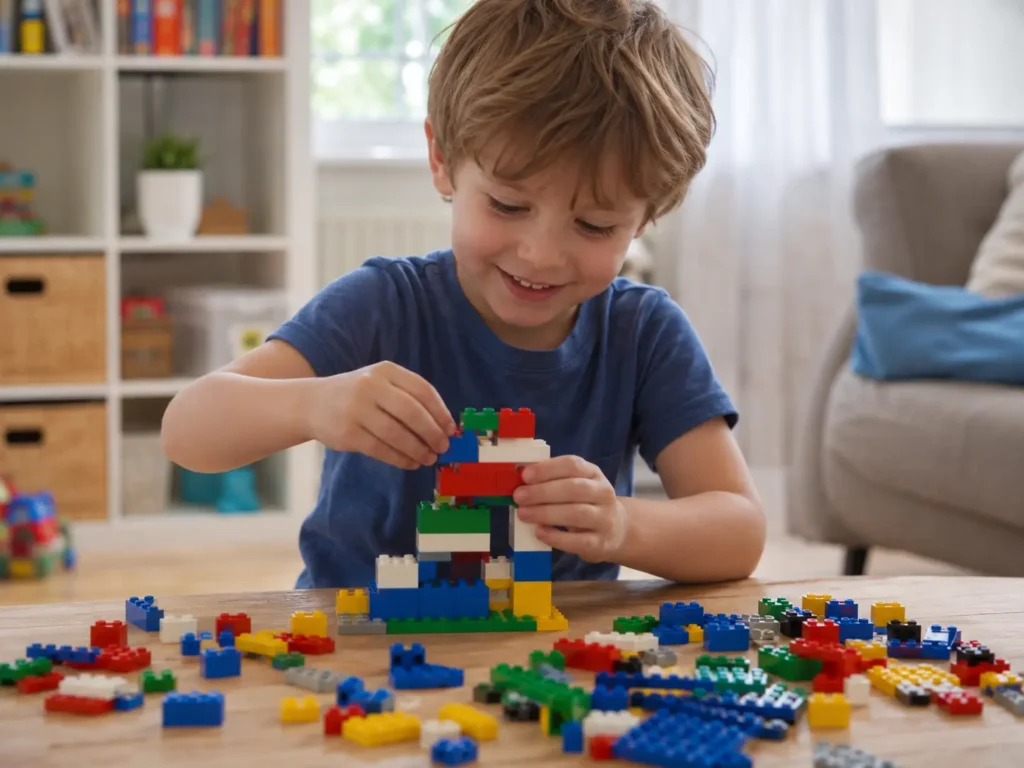
Story Retelling Activities for Early Literacy: A Play-Based Guide
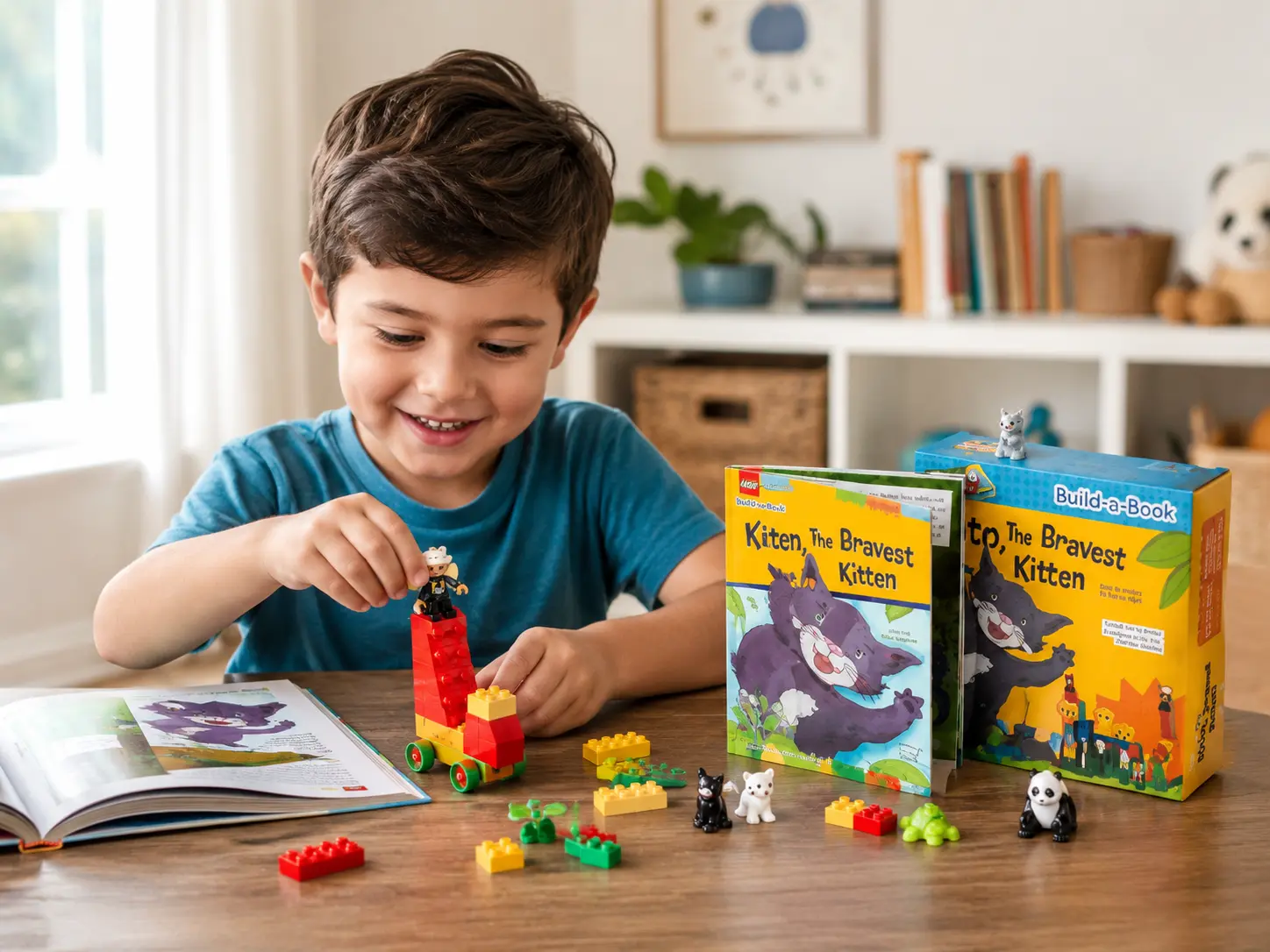
Watch any early years classroom during story time and you'll see the same pattern. Some children lean in, eyes wide. Others fidget, drift, or quietly check out by page three. The book ends, the educator asks, "So what happened in the story?" — and the room goes quiet.
That silence isn't a lack of interest. It's often a sign that listening alone didn't give children enough to hold onto. This is where story retelling activities change the picture. Retelling — asking a child to reconstruct a story in their own words, in sequence — is one of the strongest indicators of genuine comprehension, and one of the most practical skills educators and parents can build every single day.
The good news: retelling doesn't require worksheets or extra prep. It can be built through play. At Six Bricks Learning, we've seen how putting DUPLO®-style bricks into children's hands during story time transforms passive listeners into active storytellers. In this guide, we'll unpack why retelling matters, the cognitive science behind it, and how a hands-on routine — read, build, share, retell — makes it stick for every learner, including children who find sitting and listening hard.
Quick Overview
- Who is this for? Early childhood educators, Pre-K and K–2 teachers, learning support specialists, and parents of early learners.
- What will you learn? Why story retelling is a core early literacy skill, the science behind hands-on retelling, and a four-step routine you can run this week.
- Key takeaway: Children understand and remember stories far better when they build and retell them — not just hear them.
What Is Story Retelling — and Why Does It Matter?
Story retelling is a child's reconstruction of a story in their own words, in the right order — characters, setting, problem, and resolution. It matters because retelling is where comprehension becomes visible: a child can nod along to any book, but they can only retell a story they have actually understood.
Retelling sits at the intersection of several foundational literacy skills:
- Vocabulary — children reuse and internalize the words they heard.
- Comprehension — retelling requires understanding, not just recall of isolated moments.
- Sequencing — first, next, then, finally: the backbone of narrative and, later, of writing.
- Oral language — children practice forming complete, connected sentences.
- Narrative structure — an intuitive feel for how stories work, which later supports both reading and writing.
Developmental research broadly supports the view that strong oral language and narrative skills in the early years are closely linked to later reading success. A child who can retell a story at five is rehearsing the exact mental moves they'll need to comprehend written texts at seven and eight.
The Science: Why Retelling Works Better With Hands
A child retelling a story is running a serious cognitive workout — and the heaviest lifting is done by working memory, the brain's ability to hold and use information in real time. To retell even a simple story, a child must hold the characters in mind, keep events in order, and translate all of it into spoken sentences — simultaneously. Research consistently shows that working memory is one of the strongest predictors of early academic success, and it is highly trainable in early childhood.
This is exactly why hands-on retelling outperforms "sit still and tell me" retelling for many children:
- Multi-sensory learning strengthens memory encoding. When children engage touch, sight, and sound together — building a scene while talking about it — the story gets anchored in more than one channel. Evidence from play-based learning studies indicates that children working with tactile materials show improved attention and recall compared to purely visual or auditory instruction.
- Embodied cognition supports understanding. When children physically construct the tall giraffe or the lonely crocodile, the concept lives in their hands as well as their heads. Embodied cognition theory holds that handling and moving objects builds stronger conceptual understanding than listening alone.
- The build acts as an external memory aid. A child's brick model of the story becomes a visible sequence they can point to while retelling — reducing the working memory load and letting them focus on language.
Retelling and the Zone of Proximal Development
Vygotsky's Zone of Proximal Development reminds us that children grow most when gently stretched — given challenges just beyond what they can do alone, with the right support. A brick build is a natural scaffold: a child who can't yet retell a whole story verbally can point to their build and narrate one scene at a time, with an adult supplying connecting words. Over weeks, the scaffold fades and independent retelling emerges.
Passive Listening vs. Active Retelling: What Actually Changes
The shift from listen-only story time to a build-and-retell approach changes the child's role from audience member to co-constructor. Here's the practical difference:
| Listen-Only Story Time | Build-and-Retell Story Time | |
|---|---|---|
| Child's role | Passive audience | Active co-constructor |
| Attention | Fades for movement-oriented learners | Sustained by the hands-on task |
| Comprehension check | "Did you like it?" | Visible in the build and the retell |
| Vocabulary | Heard once | Heard, spoken, and used |
| Participation styles | Favors verbal, still learners | Includes tactile, visual, and low-verbal learners |
| What's left afterward | Nothing to reference | A build to share, photograph, and retell from |
This is also playful learning done properly. The LEGO Foundation's research identifies five characteristics of playful learning: the experience must be joyful, meaningful, actively engaging, iterative, and socially interactive. A build-and-retell routine hits all five — children enjoy it, connect it to a story that matters to them, stay minds-on, rebuild and revise, and share their builds with peers.
How Build-a-Book Turns Story Time Into a Retelling Routine
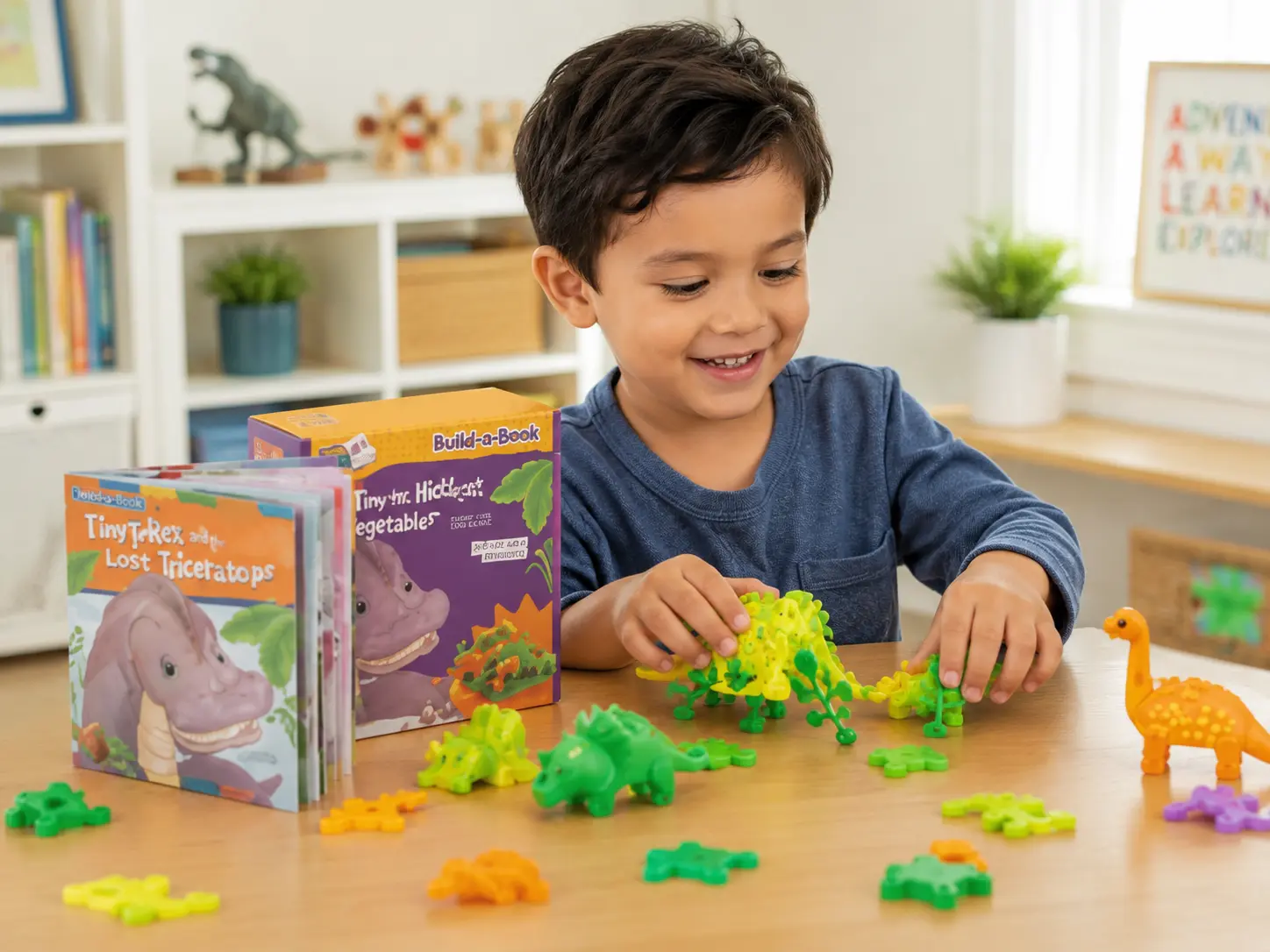
Build-a-Book is our structured storytelling resource designed around exactly this principle: children don't just listen — they build what they hear. Each title pairs a narrative with brick-building prompts, so the retelling routine is built into the book itself.
The classroom cycle has four steps:
- Read a page of the story aloud.
- Build the scene using the six bricks.
- Share the build with a partner or the group.
- Retell the story using the builds as visual anchors.
The series currently includes five stories: Jambo, the Joyful Giraffe, Dimples, the Littlest Dinosaur, Kito, the Bravest Kitten, Diggy, the Helpful Dog, and Cracker, the Lonely Crocodile. Each works in whole-group story time, small-group rotations, or early intervention settings — and book-only editions are available for centers that already have bricks on hand.
Because the builds are open-ended, there's no "wrong" giraffe. A low-verbal child can participate fully through building and pointing. A confident talker can narrate an elaborate version. Every child accesses the same story at their own stretch point.
A Classroom Snapshot
Imagine a Kindergarten group of four working through Jambo, the Joyful Giraffe. The educator reads a page, then gives two minutes to build the scene. One child stacks yellow and orange bricks into a tall giraffe; another builds the watering hole. The educator asks each child to share one thing about their build — "Tell us what Jambo is doing here" — before reading on. At the end, the group retells the whole story in sequence, each child narrating the scene they built. Total time: about 20 minutes. Language produced per child: far more than in any listen-only story time.
Trying It at Home
Parents can run the same loop with any picture book and six bricks: read a page, ask "Can you build that part?", then let your child walk you through their build at the end. Five to ten minutes at bedtime is enough — retelling grows through short, repeated routines, not marathon sessions.
Key Takeaways
- Story retelling is one of the clearest windows into whether a child truly comprehended a story — and a foundation for later reading and writing.
- Retelling is a working memory workout, and working memory is both a strong predictor of academic success and highly trainable in early childhood.
- Building while listening turns story time multi-sensory, which strengthens attention, memory encoding, and vocabulary use.
- The read → build → share → retell cycle gives every child a way in — including tactile, movement-oriented, and low-verbal learners.
- Build-a-Book structures this routine into ready-to-use stories, with five titles suited to whole-group, small-group, and intervention settings.
- Short and repeated beats long and occasional: 10–20 minutes of build-and-retell, a few times a week, builds the habit.
FAQ
What are story retelling activities for preschoolers?
How does retelling stories help child development?
How can I help a child who struggles to retell a story?
Can I use Build-a-Book if my center already has bricks?
How long should a build-and-retell session take?
Bring Stories to Life in Your Classroom
Ready to turn story time into your most engaged part of the day? Give your learners a story they can build, share, and retell.
Explore the Build-a-Book Series