
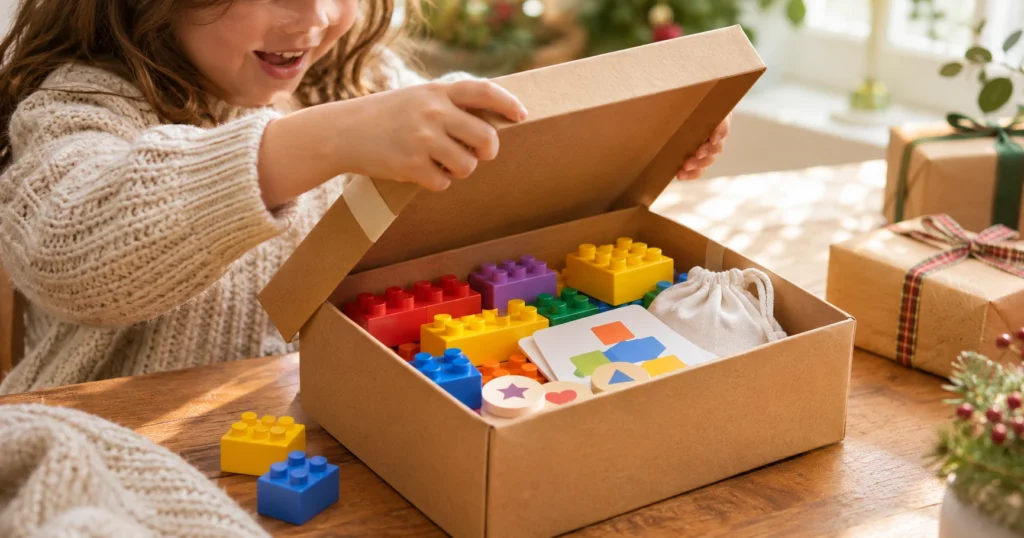
A Playful Learning Gift Guide for the 2026 Holiday Season
Every November, the same toy-aisle promise reappears on packaging everywhere: “educational.” It’s printed on flashcards, apps, light-up gadgets and plastic sets of every description, and it rarely tells a gift-buyer anything useful. By Boxing Day, plenty of those boxes are already at the bottom of the toy basket. By February, they’re forgotten.
That’s not a reflection on the child. It’s usually a sign the “educational” label was doing the selling, not the design. This playful learning gift guide shows you the few qualities a lasting gift shares. Once you know them, you can spot them in under a minute, in a shop, in a catalogue or while scrolling a Cyber Monday sale.
This week sits right in the middle of the holiday shopping season. Thanksgiving, Black Friday, Cyber Monday and Giving Tuesday all fall within the next week, alongside the run-up to Christmas and the start of the Australian summer break. At Six Bricks Learning, we spend the rest of the year helping educators choose resources that earn their place in a classroom. This guide applies the same thinking to gift-buying, with a simple by-age guide to help you choose with confidence, whoever you’re shopping for.
Quick Overview
- Who is this for? Parents, grandparents, aunts, uncles and anyone buying a gift for a child aged roughly 3–10, plus educators gifting or restocking classroom resources.
- What will you learn? Four questions that separate a gift that lasts from one that doesn’t, and a by-age guide to matching the gift to the child.
- Key takeaway: You can choose a gift this season that’s still being used well after the wrapping paper is gone.
Why Do So Many “Educational” Gifts End Up Unused?
Most unused gifts weren’t badly made. They just weren’t designed around how children actually learn. A toy can be well built, bright and marketed as developmental, and still miss the mark if it doesn’t invite repeat, evolving play.
Children don’t build a skill from one session with a toy. Executive function is the brain’s management system. Its three core skills are working memory, cognitive flexibility and inhibitory control, and they are among the strongest predictors of academic success. Research consistently shows these skills are highly trainable in early childhood. They grow through short, repeated, hands-on practice over time, not a single Christmas-morning burst of novelty.
A gift that only offers one way to play, with no room to grow, tends to be mastered or abandoned within days. The good news is that this is easy to check before you buy, rather than something you discover in January.
What Should You Look for in a Gift That Actually Lasts?
Four simple questions, drawn from the LEGO Foundation’s research on playful learning, tell you almost everything you need to know about whether a gift will hold a child’s interest. Ask them about anything on your list this season, Six Bricks or otherwise:
- Does it invite more than one way to play? A gift that can be used in a hundred different ways (building, sorting, storytelling, matching) outlasts one with a single correct outcome.
- Can the child make it harder themselves? Look for open-ended materials a child can scale up in complexity as they grow, rather than something they “complete” once.
- Does it work better with another person? Play that invites a sibling, parent or grandparent in tends to get used far more often than something designed for solo use in a corner.
- Does it use more than one sense? Multi-sensory materials, things a child can touch, see and move, tend to hold attention longer than a screen or a single-sense toy. Engaging touch, sight and movement together also strengthens memory.
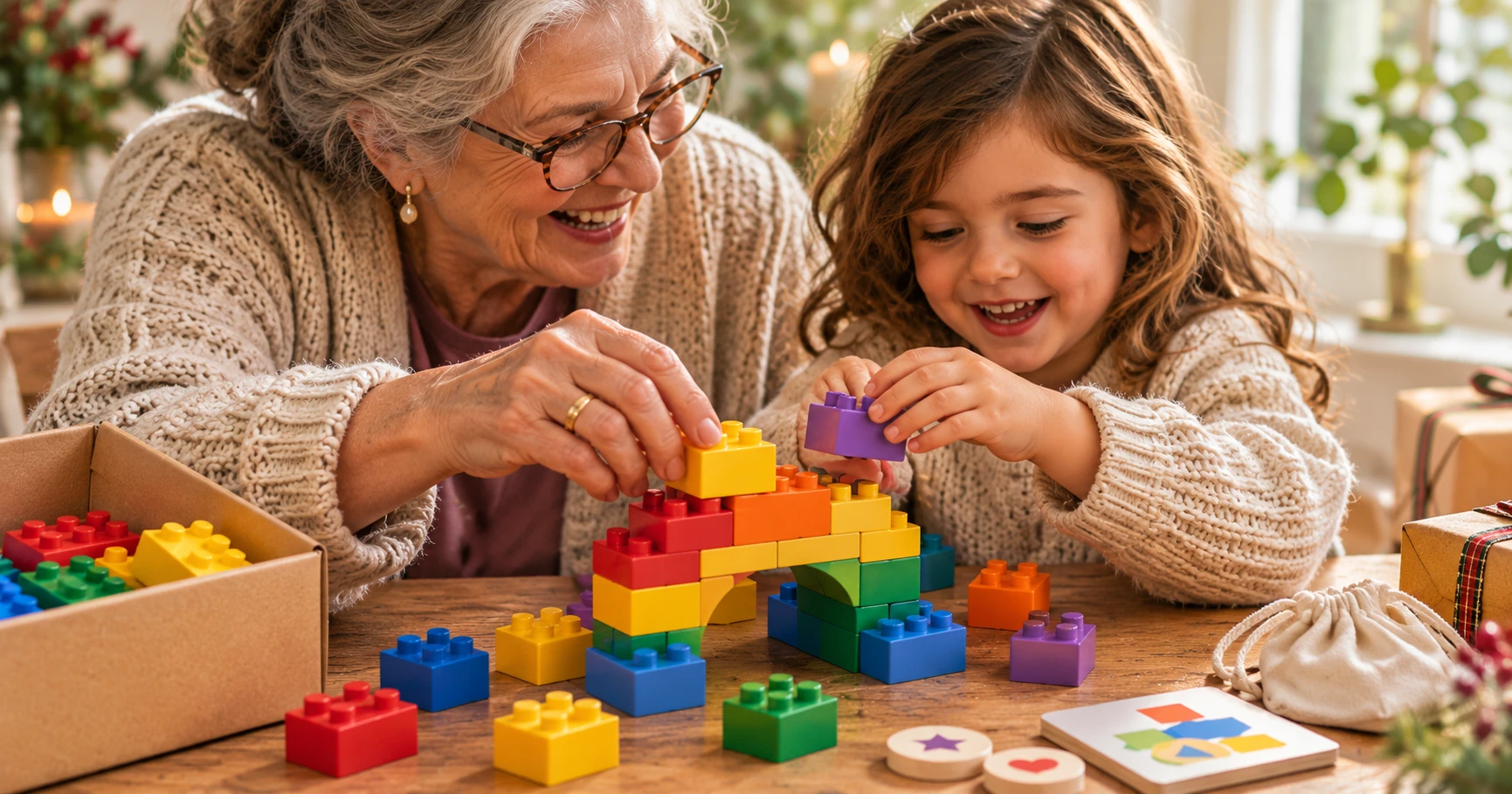
These questions map directly onto the LEGO Foundation’s five characteristics of playful learning: the experience must be joyful, meaningful, actively engaging, iterative and socially interactive. A gift that’s genuinely iterative and socially interactive is one a family comes back to in February, not just on the day it’s unwrapped.
A Gift Guide by Age and Stage
Different ages need different entry points, but the four-question test stays the same. Here’s how the rest of this playful learning gift guide maps the test to Six Bricks resources, if you’re looking for a starting point.
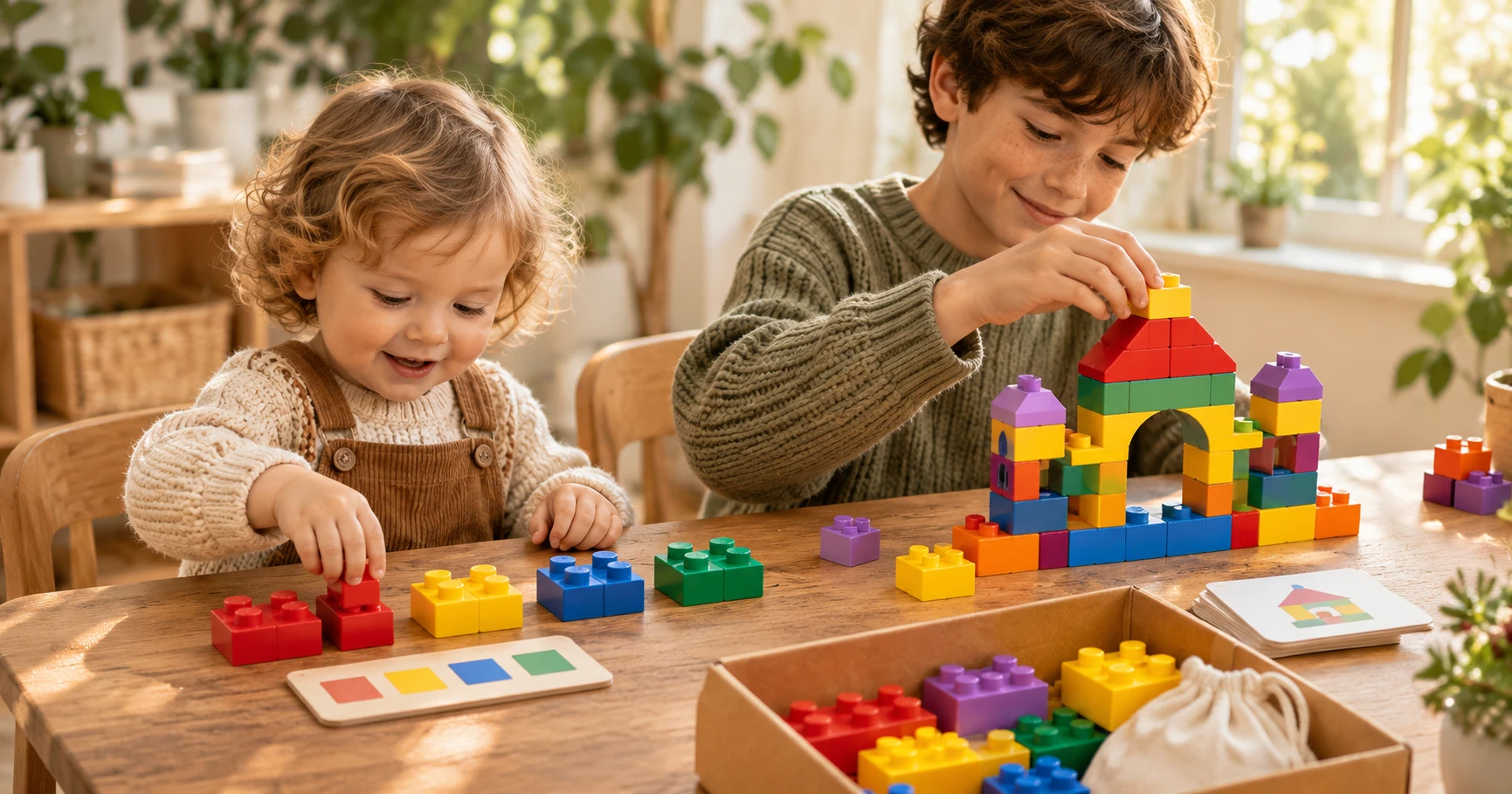
| If you’re shopping for… | Consider | Why it fits | Price (AUD) |
|---|---|---|---|
| A toddler or pre-schooler trying bricks for the first time | Small Group Kit | Bricks, grids, people, animals and emotion bricks, for a child exploring solo, with a parent or with up to three others | $190 |
| A child who loves stories | A Build-a-Book kit | Structured storytelling paired with a guided build | $100 per kit |
| A family that already owns building bricks | A Play&Learn activity deck | Ready-made activity cards that turn bricks already in the toy box into structured play | $50 per deck |
| A child who likes building upward, not just flat | Magnetic Bricks | Vertical, magnetic building that adds a new dimension to an existing collection | $85 |
| A sibling group or a home with regular visiting cousins | Large Group Kit | A classroom-scale kit designed for several children building together | $500 |
| An educator, home-schooling parent or anyone who loves learning about learning | An online course or Six Bricks Accreditation | Self-paced professional development, a thoughtful gift for the adult who shapes a child’s year | $95 per course · $250 accreditation |
Prices as listed in our online shop in November 2026, before the Black Friday discount.
Black Friday Offer
Get 30% off everything in our online shop with code BF30 at checkout. The offer runs until 30 November 2026 (AEDT) and can’t be combined with other coupons.
If you’re not sure where to start, the Small Group Kit is the most flexible choice. It works for one child at home today and for a small group of cousins or friends next month.
What Does This Look Like on Christmas Morning, and in February?
The real test of a gift is not the first morning. It’s how many ways it invites a child to keep playing weeks later. Imagine two gifts under the tree this year.
The first is a battery-powered toy that lights up and plays a tune when a button is pressed. A five-year-old presses the button a dozen times on Christmas morning and shows a grandparent twice. By New Year’s, it’s in a drawer. There has only ever been one thing to do with it.
The second is a Small Group Kit. On Christmas morning, the child sorts the bricks by colour and builds “a house for Grandma.” In January, an older cousin visiting for a few days turns it into a guessing game, building something behind a book for the younger child to copy. By February, back at preschool, the child recognises the same colours and shapes from a Play&Learn card and confidently joins in. The gift from home and the learning at preschool reinforce each other without anyone planning it that way.
Neither child is doing anything wrong. The difference is simply how many ways each gift invited them to keep playing.
Key Takeaways
- An “educational” label on a box tells you very little. Four practical questions tell you much more.
- A gift that lasts invites more than one way to play, can grow in complexity, works well with another person and uses more than one sense.
- These four questions map to the LEGO Foundation’s five characteristics of playful learning: joyful, meaningful, actively engaging, iterative and socially interactive.
- Different ages need different starting points, but the same test applies at every stage.
- A thoughtful gift for a child’s adult, such as a course or accreditation, can be just as meaningful as a gift for the child.
FAQ
What are the best educational toys for toddlers this holiday season?
Are Six Bricks kits good gifts for a family with children of different ages?
What’s the difference between the Small Group Kit and the Large Group Kit?
Can I give a Six Bricks resource as a gift for a teacher or educator instead of a child?
Is a building-brick gift suitable for a child who doesn’t like noisy or flashing toys?
Looking for a gift that’s still loved after the holidays?
Explore our Group Kits, Build-a-Book and Play&Learn ranges, or gift an online course to the educator or home-schooling parent in your life. Use code BF30 for 30% off until 30 November.
Explore Six Bricks Gifts