

AI Readiness Through Play: A K–2 Guide
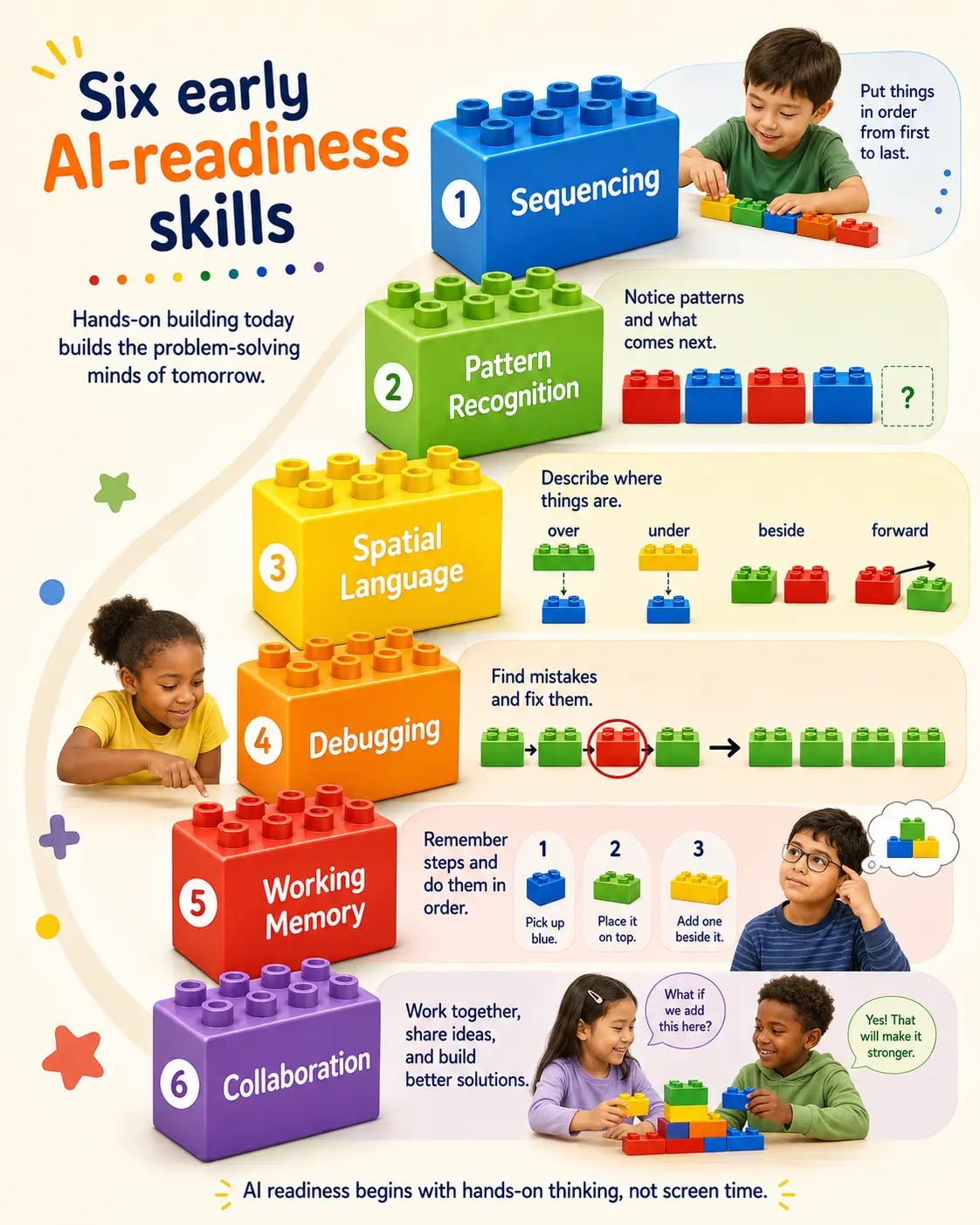
AI readiness through play may sound like a future-focused idea, but it begins in very ordinary classroom moments.
A child follows a sequence. Another notices a pattern. A small group tests an idea, changes direction, and tries again. These moments may not look like “technology learning” at first, yet they build the thinking habits children need in a world shaped by artificial intelligence.
Across education systems, AI is now part of the global conversation. The OECD’s 2026 Digital Education Outlook, for example, focuses on generative AI in learning and the need to manage both its opportunities and risks. Similarly, UNESCO stresses that AI literacy must include social, ethical, and human dimensions, not just technical use.
For early childhood and K–2 educators, this raises an important question: how do we prepare young children for an AI-rich world without pushing them into more screen time?
Six Bricks offers a practical answer. Through hands-on, structured play, children can build early computational thinking, executive function, spatial awareness, and flexible problem-solving. The Six Bricks Basic Computational and Coding Skills (K–2) course supports educators to teach these skills through playful activities such as Brick Crypto, Brick Navigation, Brick Sudoku, Tangram, and Brick Switch.
Quick Overview
- Who is this for? Early childhood educators, Foundation–Year 2 teachers, learning support practitioners, curriculum leaders, and parents of early learners.
- What will you learn? How AI readiness begins with human skills — sequencing, pattern recognition, logic, flexible thinking, self-regulation, collaboration, and language.
- Key takeaway: Children do not need to use AI tools to begin becoming AI-ready — they need rich, guided experiences that help them think clearly, test ideas, and explain their reasoning.
What Is AI Readiness Through Play?
AI readiness through play means helping children build the thinking, language, social, and problem-solving skills they will need in a world where AI is increasingly present. In K–2, this does not mean teaching children to use complex AI tools. It means strengthening the foundations that later digital literacy depends on.
Definition Block: Computational Thinking
Computational thinking is a way of solving problems by noticing patterns, breaking tasks into steps, following sequences, testing ideas, and improving solutions. These skills support coding, maths, language, reasoning, and everyday problem-solving.
Young children are already natural pattern seekers. For example, they sort objects, predict routines, repeat sounds, build towers, and notice when something is “not right.” With careful educator guidance, these everyday play behaviours can therefore become early computational thinking.
This matters because AI systems are changing how people learn, work, and communicate. Indeed, UNESCO’s work on AI and education highlights the need for equity, human rights, and child-centred approaches as technology enters learning environments. In addition, UNICEF’s updated guidance on AI and children notes that children should be supported to participate in an AI world in ways that protect their rights and wellbeing.
For young learners, the safest starting point is not more devices. It is better thinking.
Six Bricks supports this by using six DUPLO®-style bricks in six colours for short, structured, multi-sensory activities. Specifically, the methodology targets cognitive, social, emotional, physical, and language development, and activities can be adapted for individuals, pairs, or groups.
Why AI Readiness Starts Before Screens
Children need executive function before they need digital tools. Working memory, cognitive flexibility, and inhibitory control help children follow instructions, adapt to changes, manage impulses, and stay engaged with a task.
These three skills sit at the heart of executive function. The Six Bricks methodology explicitly targets working memory, cognitive flexibility, and inhibitory control through structured play activities.
This is directly relevant to AI readiness. A child who can follow a sequence, for instance, is preparing for algorithmic thinking. Likewise, spotting a pattern lays early groundwork for data awareness. And when children test an idea and then revise it, they are already practising the same flexible problem-solving used in coding, design, and digital systems.
What This Looks Like in K–2
In a K–2 classroom, AI readiness may look like:
- Children arranging bricks in a colour pattern and predicting the next step.
- A partner giving directional instructions across a grid.
- A group debugging a sequence when the “robot” reaches the wrong place.
- A child explaining, “I changed this because my first idea didn’t work.”
These are small moments, but they build durable thinking habits.
The Six Bricks Basic Computational and Coding Skills (K–2) course is especially relevant here. It is designed to help educators introduce computational thinking and early coding concepts without screens. The course includes activities that introduce encryption and pattern recognition, spatial awareness and logic, problem-solving and reasoning, algorithms, and sequential thinking.
How Six Bricks Builds Early Computational Thinking
Six Bricks builds computational thinking by making abstract ideas visible, tactile, and social. Children can hold a sequence, move a brick, test a route, or rebuild a pattern instead of only imagining it.
This matters because young children often understand best when learning is concrete. For example, embodied cognition supports the idea that thinking is grounded in physical experience. As a result, when children move objects, they build stronger conceptual understanding through action, not just through listening.
Sequencing and Algorithms
An algorithm is simply a set of steps. In early years learning, it may be as simple as: “Put the red brick first. Add yellow. Turn the blue brick sideways. Move two spaces forward.”
When children follow or create these instructions, they practise working memory and order. They also learn that precision matters. In other words, if the instruction is unclear, the result changes.
Pattern Recognition
AI systems rely on patterns. Young children do not need to understand machine learning to begin recognising, extending, and explaining patterns.
With Six Bricks, a child might build red-blue-red-blue, then predict what comes next. Similarly, another child might notice a growing pattern: one brick, then two, then three. Together, these playful tasks support early mathematical and logical thinking.
Debugging and Flexible Thinking
Debugging means finding what went wrong and trying again. In play, this can feel safe and even joyful.
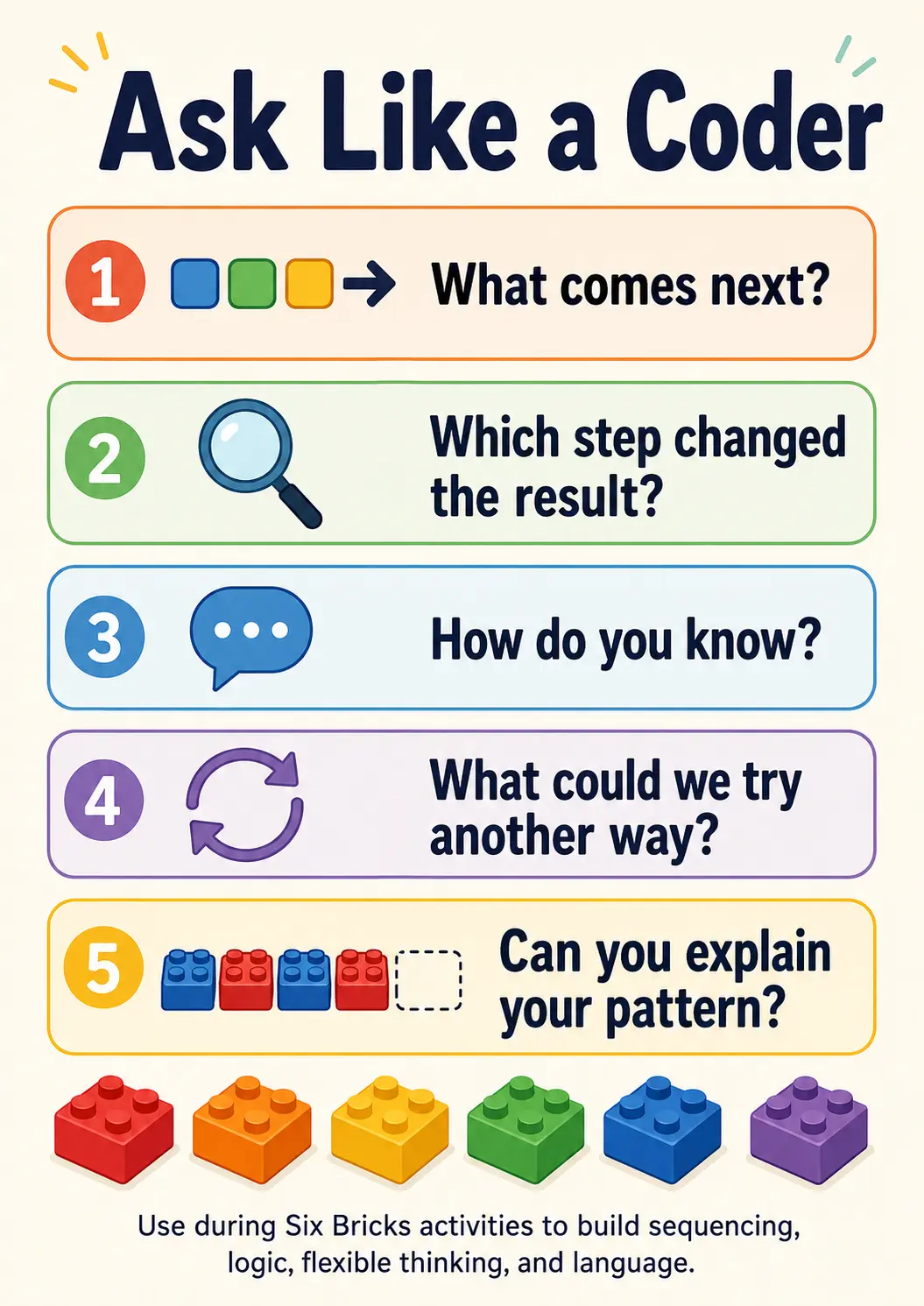
A child might give instructions that lead a partner’s brick to the wrong square. Instead of seeing this as failure, the educator can ask, “Which step could we change?” That question builds cognitive flexibility and confidence.
Spatial Logic
The Six Bricks coding course includes Brick Navigation, which develops spatial awareness and logic. Spatial reasoning is also a verified focus within the Six Bricks methodology, and the B-line mat supports spatial awareness and sequential reasoning.
This is important because spatial language — over, under, beside, between, left, right, forward, back — helps children reason about position and movement. Ultimately, these are foundational ideas for maths, coding, robotics, design, and everyday navigation.
A Classroom Snapshot: Brick Navigation for AI-Ready Thinking
A simple Six Bricks routine can help children practise sequencing, prediction, collaboration, and self-correction in under 10 minutes. This makes it realistic for busy classrooms.
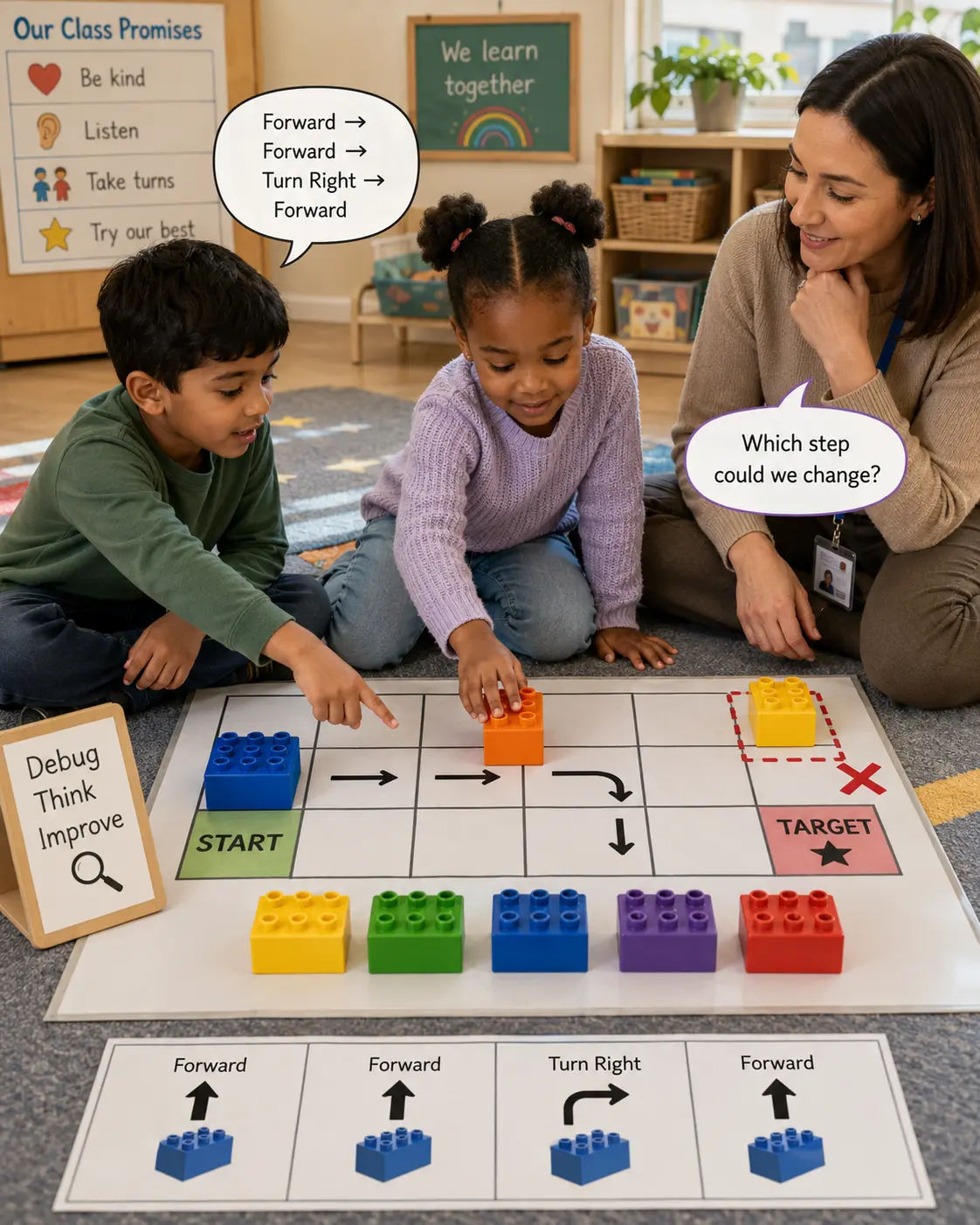
Imagine a Year 1 classroom after morning literacy. The educator places a grid on the floor and gives each pair six bricks. One child becomes the “navigator,” and the other becomes the “builder.”
The educator says: “Your orange brick needs to travel from the start square to the green brick. You may only use four instructions.”
The navigator gives a sequence:
- Move forward.
- Move forward.
- Turn right.
- Move forward.
The builder follows the steps exactly. As a result, the brick lands one square away from the target.
Instead of correcting the child, the educator asks, “What did your instructions make the brick do? What do you want it to do next?”
The children look again. One says, “We needed one more forward.” Another says, “Or we should have turned earlier.”
Now the learning deepens. They are no longer just moving bricks. Instead, they are planning, testing, debugging, using spatial language, and explaining their reasoning.
For a child who prefers movement, the activity can become whole-body navigation. Meanwhile, a child who needs lower language demands can use gesture cards or colour cues. And when a child is ready for extension, the challenge can include obstacles, fewer instructions, or a partner-created code.
This is AI readiness through play in action. It is structured, inclusive, tactile, and human.
Why This Topic Matters Now for Educators and Families
AI is already changing education, but young children still need developmentally appropriate foundations. Early learning should protect play, strengthen relationships, and build thinking skills before introducing complex tools.
The OECD’s 2026 Digital Education Outlook explores generative AI in teaching and learning, including both its promise and risks. UNESCO has also emphasised that AI literacy should go beyond technical proficiency and include social and human dimensions.
For educators, this creates a practical challenge. They may feel pressure to “prepare children for AI,” but early learners do not need adult-style technology tasks. They need developmentally sound experiences that build:
- Attention and persistence
- Working memory
- Pattern recognition
- Language for explaining ideas
- Flexible thinking
- Collaboration
- Confidence with trial and error
Six Bricks aligns well with this need because activities are short, structured, hands-on, and adaptable. For instance, they can be used as 2–5 minute brain breaks or extended into deeper 30-minute explorations.
The key is balance. AI readiness should not replace play. It should grow from play.
How to Use the Six Bricks Coding Course in a K–2 Setting
The Six Bricks Basic Computational and Coding Skills course gives educators a practical way to teach early coding concepts without relying on computers. In particular, it is useful for educators who want STEAM learning to stay active, social, and age-appropriate.
The course includes step-by-step guidance for activities such as Brick Crypto, Brick Navigation, Brick Sudoku, Tangram, and Brick Switch. These activities support pattern recognition, logic, spatial awareness, problem-solving, algorithms, and sequential thinking.
A Simple Weekly Routine
Educators could introduce one coding concept each week:
- Monday — Pattern day: Children copy, extend, and create colour patterns.
- Tuesday — Sequence day: Children follow three-step and four-step brick instructions.
- Wednesday — Navigation day: Children move bricks across a grid using positional language.
- Thursday — Debugging day: Children find and fix an error in a sequence.
- Friday — Explain-your-thinking day: Children describe what worked, what changed, and what they would try next.
This routine is simple enough for early years classrooms and flexible enough for diverse learners. In addition, it supports inclusive participation. Children can respond, for example, through words, movement, pointing, building, gesture, or partner work.
Key Takeaways
- AI readiness begins with human skills, not screen use.
- Young children build computational thinking through sequencing, patterns, logic, and problem-solving.
- Six Bricks activities make abstract ideas visible, tactile, and social.
- Executive function skills support later digital literacy and school readiness.
- The Six Bricks Basic Computational and Coding Skills course gives educators practical, screen-free ways to teach early coding concepts.
- Play remains essential in an AI-rich world because it develops flexible, creative, and collaborative thinkers.
FAQ
What is AI readiness through play?
Can young children learn coding without screens?
How does Six Bricks support computational thinking?
Is AI readiness appropriate for early childhood classrooms?
What Six Bricks product is best for teaching early coding?
Written by the Six Bricks Learning Content Team. Six Bricks Learning creates practical, evidence-aligned resources that help educators and caregivers nurture children’s cognitive, social, emotional, physical, and language development through structured play.
Build AI-ready thinking — without more screen time
Explore the Six Bricks Basic Computational and Coding Skills (K–2) course and help young learners develop sequencing, logic, pattern recognition, and flexible problem-solving through hands-on play.
Explore the K–2 Coding Course