
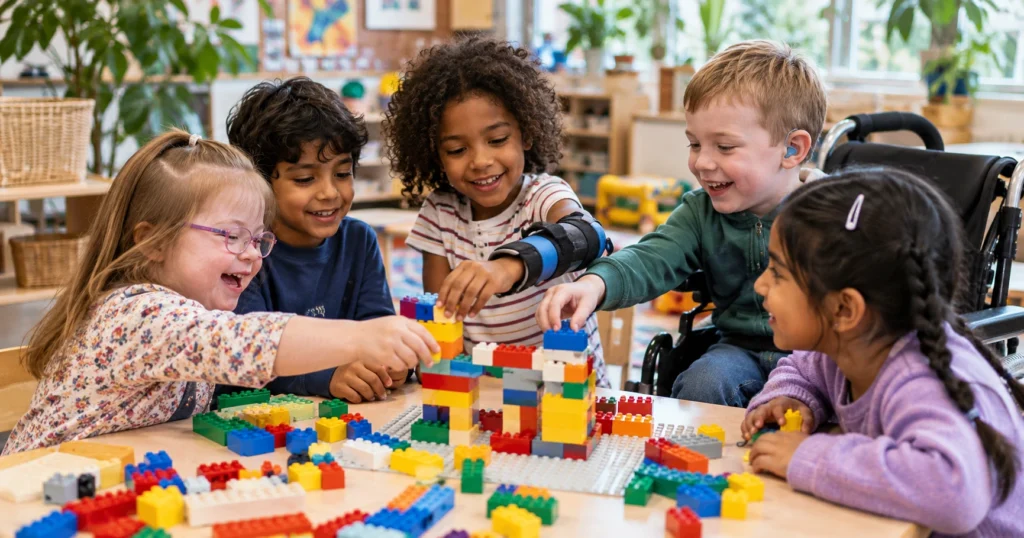
Inclusive Play Spaces for International Day of Persons with Disabilities
On 3 December each year, International Day of Persons with Disabilities asks workplaces, schools and communities to look honestly at how included disabled people really are in everyday life. Not just in policy documents, but in the rooms where life actually happens. For early childhood and primary settings, one of the most everyday rooms is the play space, which makes inclusive play spaces a good place to start.
Play is often described as “just” play, which can make it feel like a lower-stakes place to get inclusion right. The opposite is true. Play is often where a child first discovers whether a space was designed with them in mind. Can they join in the way they move, communicate and process the world? Or do they have to work around the space to take part at all?
This isn’t about creating a separate “disability corner” or a shelf of adapted toys to bring out occasionally. It’s about building play spaces and routines that work for the widest range of children from the start. To mark International Day of Persons with Disabilities, we share four practical, low-cost ways to make everyday play more inclusive, plus a short scenario showing what it can look like in a real classroom.
Quick Overview
- Who is this for? Early childhood and primary educators, learning support specialists, centre leaders, and parents and carers of children with disability.
- What will you learn? Four practical principles for building inclusive play spaces and routines, grounded in developmental research.
- Key takeaway: A play space and routine can work for more children by design, without singling anyone out.
Why Does Inclusive Play Deserve Its Own Day?
International Day of Persons with Disabilities exists because inclusion doesn’t happen automatically. It has to be designed in. The World Health Organization estimates that 1.3 billion people, about 16% of the global population or 1 in 6 of us, experience significant disability. That includes physical, intellectual, sensory and developmental differences, which are not interchangeable and don’t call for identical responses.
In a classroom or playroom, that diversity shows up as different ways of moving, communicating, processing sound and light, and regulating attention and emotion. A play space designed around only one of those profiles can quietly exclude other children. Often that profile is a child who sits still, listens and responds verbally. Children who need to move to think, who communicate without words, or who find certain lighting or noise overwhelming can be left on the edges.
The strength-based question is not “which children need extra help to fit into this space?” It’s “how can this space fit more children from the outset?” That shift in framing is the difference between accommodation and genuine inclusion.
What Do Inclusive Play Spaces Actually Look Like?
Four practical principles, each grounded in developmental research, do most of the work. None of them require a large budget or a specialist on staff.
- Make it multi-sensory, not single-sensory. Materials that can be touched, seen and moved, not only looked at or listened to, give more children a way in. Multi-sensory learning strengthens memory encoding for all children. It also gives children who find spoken instructions difficult another route into the same activity.
- Make participation possible without words. Pointing, placing, sorting and building let a child show understanding and make choices without relying on spoken language. This matters for children who are non-speaking or minimally speaking, and for children still building vocabulary in a second or third language.
- Build in predictability. A visual schedule, a consistent routine and short, clearly bounded activities (two to five minutes works well) help children who find unpredictability distressing. They still work perfectly well for children who don’t.
- Design for more than one way to participate. The same activity should be open to a child building independently, a child building alongside an adult, and a child directing someone else to build for them. Nobody should need an “easy version” that sits apart from everyone else’s.
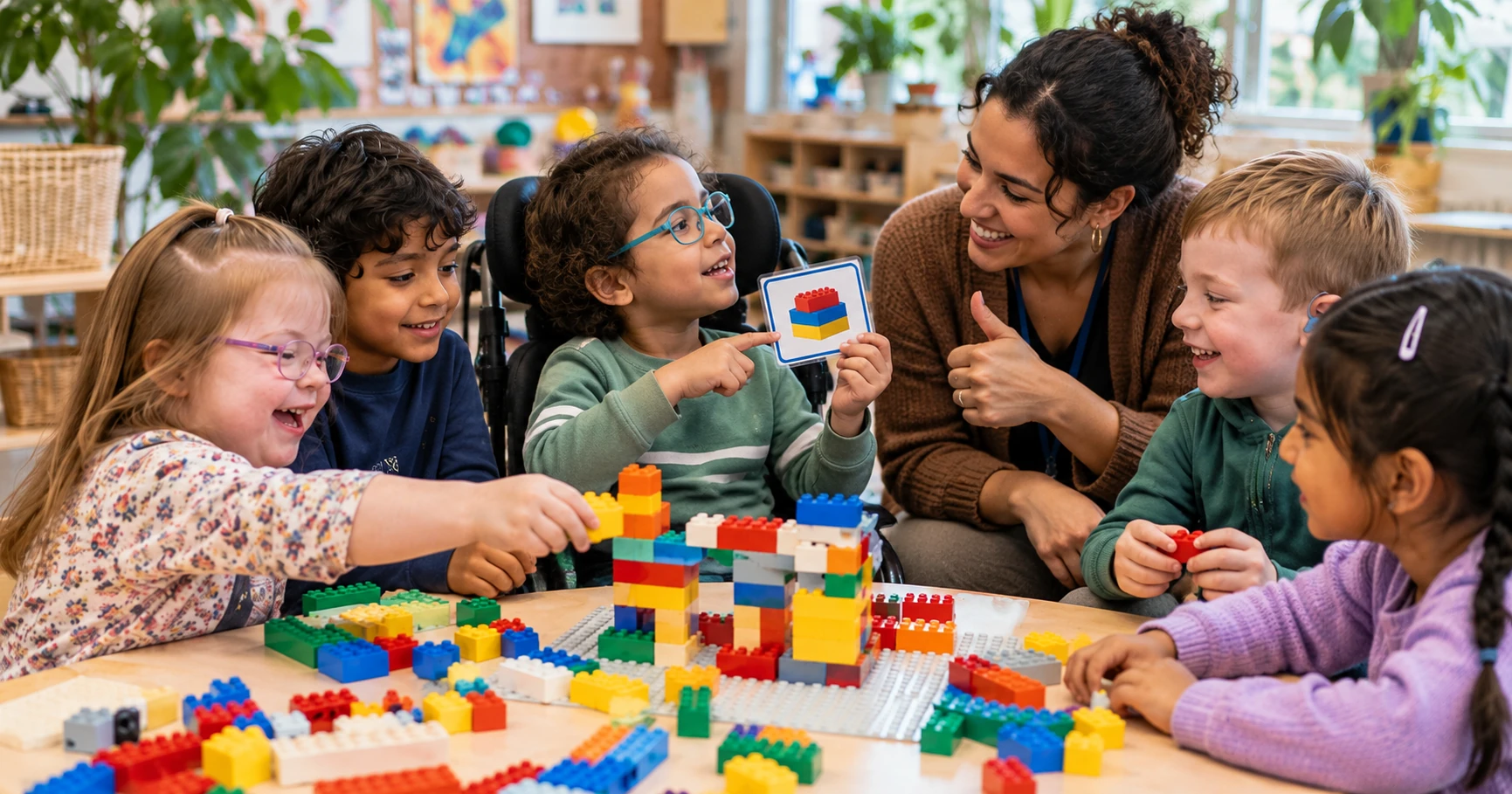
These four principles echo the LEGO Foundation’s five characteristics of playful learning: joyful, meaningful, actively engaging, iterative and socially interactive. Genuine play should be actively engaging and socially interactive for everyone involved, not just the children the space was originally designed for.
Predictability also supports self-regulation, one of the most important and most teachable skills children develop in early childhood. Short, predictable play routines help children build calm engagement and smoother transitions.
What Does This Look Like in a Real Classroom? A Scenario
In a well-designed activity, every child takes part in the same task at the same time, in the way that works for them. Imagine a Foundation classroom running a short group activity before International Day of Persons with Disabilities. The educator sets out a Small Group Kit and a simple prompt: “Build something that keeps you safe.”
One child, who uses a small number of core words and some signing, builds quietly and then points to a picture card to show “home.” Another child, who finds sitting still difficult, builds standing at the table, moving between two spots, and finishes just as quickly as everyone else. A third child, who uses a wheelchair, builds at the same table height as his peers, with no separate station or activity.
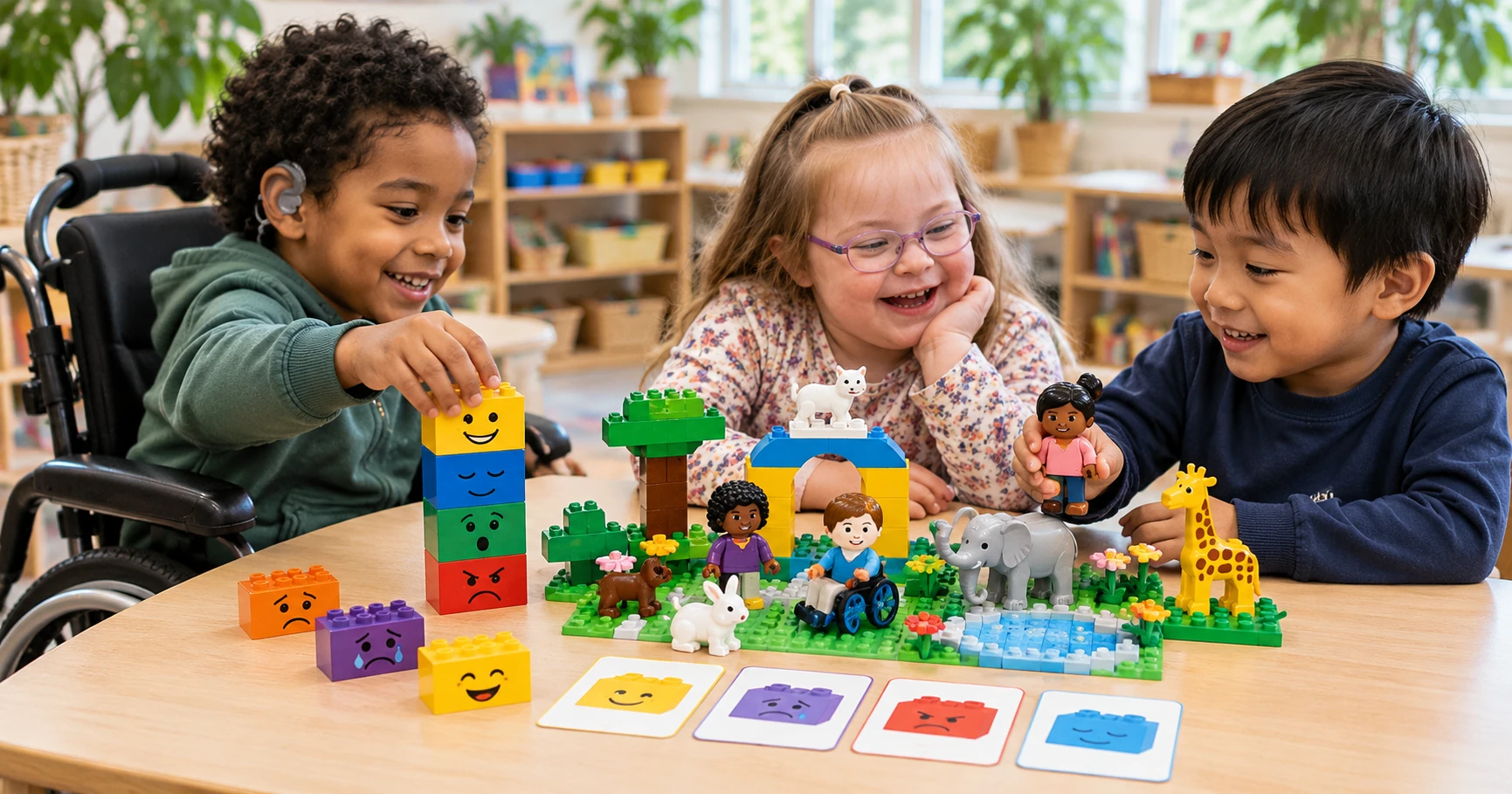
The educator doesn’t treat any of this as an adaptation made for one child. The activity was built from the start to work with pointing, standing, signing or seated building. Its two-minute length suits a shorter attention span as well as a longer one. Afterwards, each child shares their build in whatever way works for them: a word, a point, a gesture, or simply showing it. Everyone has taken part in the same activity, at the same time, without anyone’s version looking lesser.
Six Bricks is a learning tool, not a therapy or a diagnostic approach. It doesn’t replace the guidance of an occupational therapist, speech pathologist or other professional working with a specific child. What it offers is a flexible, open-ended material that bends easily to a wide range of participation styles. The Small Group Kit includes bricks, grids, emotion bricks, people and animals, so educators don’t need to redesign an activity from scratch each time.
How Can You Prepare Your Setting Before 3 December?
A short audit of one play area and one routine is enough to start. You don’t need to redesign the whole room before the day itself. Try these steps with your team this week:
- Watch one play session. Note who joins easily, who hovers at the edges and what seems to get in the way.
- Check the materials. Can each one be used by touching, building or pointing, not only by talking?
- Check the space. Is there room to stand, sit on the floor or work at an accessible table height?
- Pick one routine. Make it shorter and more predictable, and add a visual cue for the start and finish.
- Plan the share-back. Offer more than one way to show work at the end: a word, a point, a gesture or holding it up.
Small changes like these benefit every child in the room, and they keep working long after International Day of Persons with Disabilities has passed.
Key Takeaways
- Inclusion in play has to be designed in from the start. It rarely happens by accident.
- Disability is diverse: physical, intellectual, sensory and developmental differences call for different things, not one-size-fits-all adaptations.
- Four principles help most: multi-sensory materials, participation without words, predictable short routines and more than one way to join in.
- The strongest inclusive activities don’t separate out an “adapted version” for some children.
- Six Bricks is a learning tool that supports inclusive practice. It is not a substitute for professional therapeutic or diagnostic support.
FAQ
What is International Day of Persons with Disabilities?
How can I make my classroom’s play area more inclusive without a big budget?
How can non-speaking children take part in group play activities?
Does inclusive play mean treating every child the same way?
Can play-based tools like Six Bricks replace occupational therapy or other professional support?
Want to build a more inclusive play space?
Explore our Group Kits with emotion bricks and people pieces, or build your team’s confidence with a Six Bricks online course ahead of International Day of Persons with Disabilities.
Explore the Small Group Kit