
Fine Motor Skills Activities for Preschoolers: A 2026 Classroom Guide
Watch four children at a drawing table and you will see the whole developmental range inside a minute. One wraps a whole fist around the pencil and presses hard enough to tear the page. Meanwhile, another holds it lightly between three fingers and hums while she works. Yet a third keeps swapping hands. The fourth, of course, has already put the pencil down and wandered off.
None of that is really about handwriting yet. Rather, it is about hands — the strength, control and coordination that have to come first. That is why fine motor skills activities for preschoolers matter so much in the year or two before formal schooling. In fact, the physical foundations for writing are laid long before a child is ever asked to form a letter.
However, the problem for most educators is not knowing this. Instead, it is finding room for it. Fine motor work tends to get squeezed into craft time, and then squeezed out again when the term gets busy. Six Bricks activities offer a different route: short, structured, repeatable sequences that build hand strength inside the five minutes you already have.
So this guide covers the five skills beneath pre-writing readiness, five brick activities you can run tomorrow, and finally how to choose the right setup.
Quick Overview
- Who is this for? Early childhood educators, Pre-K and Foundation teachers, learning support staff, and parents.
- What will you learn? The five fine motor skills behind pre-writing readiness, and the brick activities that build them.
- Key takeaway: Hand strength is built through short, frequent, hands-on practice — not through longer worksheets.
What are fine motor skills — and why do they matter before school?
Fine motor skills are the small, precise movements of the hands and fingers: the control a child needs to pinch, twist, press, place and release. In particular, they sit inside the physical domain — one of the five developmental areas the Six Bricks methodology is built around, alongside cognitive, social, emotional and language development.
Still, these skills do far more than prepare a hand for a pencil. For example, a child with limited hand strength tires quickly during drawing and therefore avoids the activity altogether. Over time, that avoidance compounds: less practice, less strength, less confidence.
Embodied cognition research supports what educators already notice on the floor. When children handle and move real objects, they build stronger conceptual understanding than they do from watching alone. In other words, the hands are not a side channel for learning. They are part of the thinking.
Moreover, fine motor development feeds directly into the independence that makes a classroom run. Before school, for instance, children are expected to manage:
- Zips, buttons, press studs and shoe fastenings
- Lunchbox lids, drink bottles and food packaging
- Scissors, glue sticks and small construction pieces
- Turning single pages in a book without tearing them
- Packing away and sorting resources at transition time
Each of those is a fine motor task before it is a behaviour expectation. So a child who cannot open a lunchbox is not being difficult at eleven o'clock. Rather, they are running out of hand strength.
The five fine motor skills preschoolers need before they can write
Pre-writing readiness is not one skill. Instead, it is a stack of five, and each one supports the next. As a result, knowing which is which changes what you notice during small group time.
| Skill | What it looks like | Why it matters for writing |
|---|---|---|
| Hand and finger strength | Pressing, squeezing and pulling apart resistant materials without giving up | Sustains grip pressure across a whole page instead of a single line |
| Pincer grasp | Picking up small items with thumb and index finger rather than a whole hand | Forms the basis of a mature, efficient pencil grip |
| Bilateral coordination | Two hands doing different jobs — one stabilising, one working | Lets one hand hold the paper steady while the other writes |
| In-hand manipulation | Moving an object around within one hand without the other helping | Supports pencil repositioning and control of small movements |
| Visual-motor integration | Eyes guiding hands to copy a shape, pattern or sequence accurately | Underpins letter formation and copying from a board |
Educational neuroscience points to a consistent pattern here: skills that are practised in a multi-sensory way, engaging touch and sight together, tend to be encoded more strongly than skills practised through one channel alone. Therefore, that is a good argument for putting something solid in a child's hand rather than another pencil.
Five fine motor activities you can run with six bricks
The most effective fine motor skills activities for preschoolers are short, repeated and physically resistant. DUPLO®-style bricks suit this well, because they push back — separating them takes real effort, and that effort is the exercise.
Each of the following runs in two to five minutes with six bricks per child. Above all, keep the pace calm.
Five activities to run this week
- Pull-apart warm-up. Children press all six bricks into one tower, then take it apart one brick at a time. Then repeat three times. This is straightforward strength work, and therefore the single best warm-up before any writing or drawing task.
- One-handed stacking. Build a six-brick tower using only the dominant hand, while the other hand stays flat on the table. As a result, the working hand does all the pressing and separating on its own.
- Pincer transfers. Using the smaller bricks from the kit, children move pieces one at a time from a grid to a mat using only thumb and index finger. However, slow is the point here, not speed.
- Feel and find. Place three bricks behind a screen or under a cloth. The child reaches in, feels the pieces, and pulls out the one you name by colour or size — without looking. Thus it builds in-hand manipulation and tactile discrimination together.
- Copy the sequence. Lay out a colour pattern of four bricks. Children rebuild it from memory or by copying, and then check. In short, this connects visual-motor integration with working memory, which is where fine motor work starts feeding straight into cognitive development.
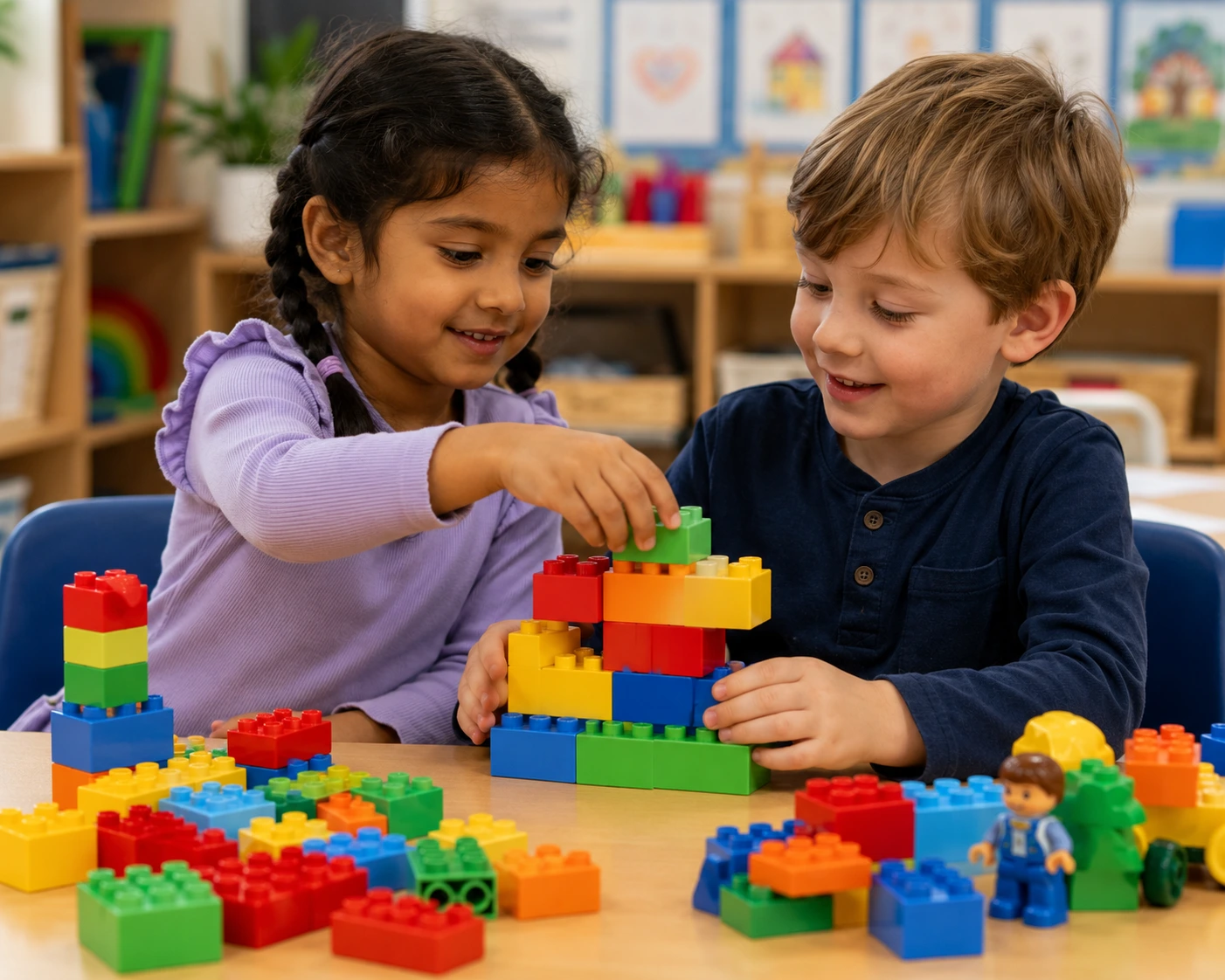
If you already run brain break activities for the classroom, these slot into exactly the same window. In effect, you are changing what the break is training.
A classroom snapshot: the four-child fine motor rotation
Imagine a Pre-K room on a Tuesday morning. Four children sit at a low table with the educator while the rest of the group works in learning centres. Each child has six bricks and a small grid in front of them. In total, the rotation takes six minutes, and it runs the same way every day.
- First, two minutes of pull-apart warm-up, counting the bricks out loud together.
- Next, two minutes of one-handed stacking, while the educator names what each hand is doing.
- Finally, two minutes of copy-the-sequence, with one child setting the pattern for the others.
Then the group rotates and the next four sit down. Over a morning, every child in the room has had focused fine motor practice with an adult watching closely — which is very difficult to achieve any other way.
What the educator is watching for
Above all, the value of the small-group format is observation. Because you are sitting with four children rather than twenty-four, you can see things that a whole-class activity hides.
- Which hand a child reaches with, and whether that changes mid-task
- Whether the non-dominant hand stabilises or sits idle
- Whether a child uses a pincer grip or scoops with the whole hand
- How quickly the hand fatigues, and what the child does when it does
- Whether frustration shows up as avoidance, silliness or withdrawal
Those notes are worth keeping. In particular, they give you something concrete to share with families, and something specific to raise with an occupational therapist if a child needs more support.
Adapting the activities for every learner
Brick activities are already accessible by design, which is part of why they are used by teachers, occupational therapists, speech therapists and home educators alike. Indeed, the structure is predictable, the language demand is low, and the materials are the same for everyone at the table.
Even so, a few adjustments make them work for a wider range of learners without singling anyone out.
- For children who need more support with strength: start with two bricks rather than six, and pre-loosen the connection slightly. So success comes first, resistance second.
- For low-verbal or multilingual learners: model the action silently, then invite imitation. Colour, after all, is a universal instruction — no English required.
- For children who are sensory-sensitive: offer the option to work on a mat rather than a bare table, and let them choose their bricks instead of being handed a set.
- For children who need movement: run the activity standing at a bench. Alternatively, place the brick supply across the room so that each piece involves a walk.
Vygotsky's Zone of Proximal Development is a useful frame here. Children grow most, therefore, when they are gently stretched — given a challenge just beyond what they can manage alone, with enough support to make it feel achievable. In practice, adding one brick or removing one is often the entire adjustment needed.
How to choose the right Six Bricks setup for your setting
Ultimately, the right starting point depends on how many children you need to reach at once, and on whether you want the methodology training alongside the materials.
Which group kit fits your setting?
- Choose the Small Group Size Kit ($175) if you run targeted small-group rotations, a calm corner, a learning support caseload, or a home setting. It supports up to four children and includes bricks, grids, people, animals, smaller bricks and emotion bricks, plus access to the online learning portal.
- Choose the Large Group Size Kit ($475) if you want to run whole-class rotations without recycling one set between groups. It supports up to sixteen children with the same inclusions and portal access.
Training, funding and where to start
- Add an online course ($95) if your team wants structured professional development — including courses focused on maths, autistic children, computational and coding skills, and applying the method in K–2 classes.
- Start with a free introductory webinar if you want to see the methodology in action before committing to anything.
Australian services should also know that Six Bricks Learning programs are approved for Queensland Kindy Uplift funding. If you are in Queensland, it is worth checking whether your centre qualifies before you budget for it.
Whichever you choose, the fine motor work does not stay in the fine motor lane for long. The same bricks that build hand strength also build the spatial reasoning that underpins early numeracy — which is why spatial awareness matters so much for maths readiness.
Key Takeaways
- Handwriting readiness starts in the hands — strength, grip and coordination come before letter formation.
- Five skills underpin pre-writing: hand strength, pincer grasp, bilateral coordination, in-hand manipulation and visual-motor integration.
- The best fine motor skills activities for preschoolers are short, frequent and physically resistant, not long and passive.
- Small-group rotations let you observe individual hand use in a way whole-class activities cannot.
- Adjust by adding or removing a brick — every child stays at the same table doing the same activity.
- Six bricks and five minutes a day is a realistic routine for a busy room, not an aspiration.
FAQ
Questions about fine motor skills and activities
What are fine motor skills in early childhood?
What are the best fine motor skills activities for preschoolers in a classroom?
Can Six Bricks help with pencil grip?
How long should a fine motor activity last for a four-year-old?
Questions about kits and funding
What is the difference between the Small and Large Group Size Kit?
Is Six Bricks approved for Queensland Kindy Uplift funding?
Written by the Six Bricks Learning Content Team. Six Bricks Learning brings over 34 years of experience in education to play-based resources and professional development for educators, therapists and families. We work to make structured, evidence-aligned play practical inside real classrooms.
Bring structured fine motor practice into your rotations
Our Group Kits give every child six bricks and give you a repeatable five-minute routine — with online portal access included.
Explore our Group Kits