

Six Bricks is a playful yet powerful framework for early learning, designed to strengthen children’s cognitive, emotional, and motor development through simple, engaging activities.
Using just six brightly coloured DUPLO®-sized bricks, educators and families can open the door to hundreds of learning opportunities. Each activity is carefully crafted to build critical thinking, problem-solving, memory, and collaboration skills — all within a hands-on, play-based learning approach.
This method is especially effective for children aged 3–7 years, offering both structure and creativity within everyday learning.
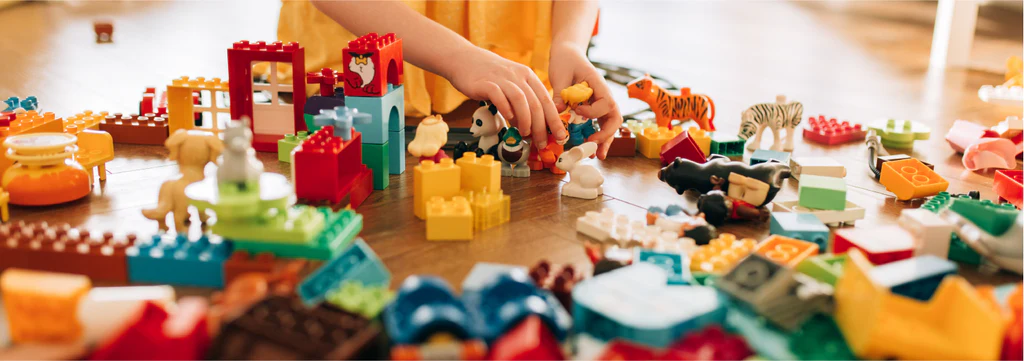
The Benefits of Six Bricks in Education
Building Cognitive & Physical Skills
Six Bricks activities target multiple areas of cognitive growth while supporting fine motor development. With more than 300 structured activities available, children can:
- Strengthen memory and attention through playful challenges.
- Improve colour recognition, spatial awareness, and sequencing.
- Develop fine motor control that supports writing, drawing, and coordination.
Because the activities are tactile, they help children learn in ways that feel natural, enjoyable, and developmentally aligned.
Fostering Social Growth & Collaboration
Six Bricks is also a tool for building communication and social skills. In group settings, children learn to:
- Share ideas clearly and listen actively.
- Solve challenges together through teamwork.
- Build empathy, patience, and confidence in expressing themselves.
What’s remarkable is how deeply children immerse themselves in these tasks, often unaware of the wide range of skills they are building with every game.

Inspiring Creativity & Flexible Thinking
The beauty of Six Bricks lies in its versatility. With endless variations, children can:
- Create patterns and sequences.
- Solve puzzles and logic challenges.
- Invent their own games and rules.
This multi-sensory learning approach nurtures creativity, innovation, and adaptive thinking, encouraging children to experiment and find new ways of solving problems.
How to Implement Six Bricks in Learning Environments
Step-by-Step Activity Guide
- Introducing the Bricks – Begin by exploring the colours and textures, making the materials feel familiar and exciting.
- Simple Building Tasks – Stacking, balancing, and aligning bricks to practise coordination.
- Pattern & Sequence Games – Challenge children to copy or extend colour sequences.
- Memory Boosters – Briefly show a sequence, then ask children to recreate it from memory.
- Team Challenges – Encourage groups to design and build together, strengthening cooperation.

Classroom Integration
Six Bricks can fit seamlessly into any curriculum. Educators often use them for:
- Warm-ups to activate children’s focus before a lesson.
- Brain breaks to help reset energy and attention.
- Transitions between activities.
- Classroom management tools to engage children positively.
These activities work across all levels of ability, making them especially valuable for inclusive learning, including children on the autism spectrum.
Success Stories Around the World
Educators across early learning centres, primary schools, and family daycare programs have reported:
- Stronger problem-solving abilities.
- Higher engagement and concentration in lessons.
- Noticeable improvements in teamwork and communication.
Six Bricks has grown into a global community of practitioners, all using playful learning to make education more impactful.
Final Thoughts
Six Bricks provides an accessible, flexible, and research-backed way to enrich early learning. By embedding these playful activities into classrooms and homes, educators can help children grow in:
- Cognitive development
- Social skills
- Mathematical exploration
- Creative thinking
This approach makes learning joyful, inclusive, and highly effective — setting children up for lifelong success.
FAQ
Q: What age group is Six Bricks best for?
Children between 3–7 years benefit most, though activities can be adapted for older learners.
Q: Can parents use Six Bricks at home?
Absolutely. Families can integrate activities into everyday play, making learning a natural part of home life.
Q: Is special training required?
Educators can start with simple activities immediately, but professional training and certification can unlock the full potential of the method.
About the Author
Six Bricks Learning is dedicated to bringing playful, hands-on educational strategies into classrooms and homes worldwide. Our mission is to empower educators and families with accessible tools that nurture lifelong learning.
Start Your Six Bricks Journey
Ready to bring the power of playful learning into your teaching practice? Explore our certification programs and hands-on resources to start making a difference today.
Explore Programs & Resources