
Documenting Play-Based Learning: A 2026 Educator Guide
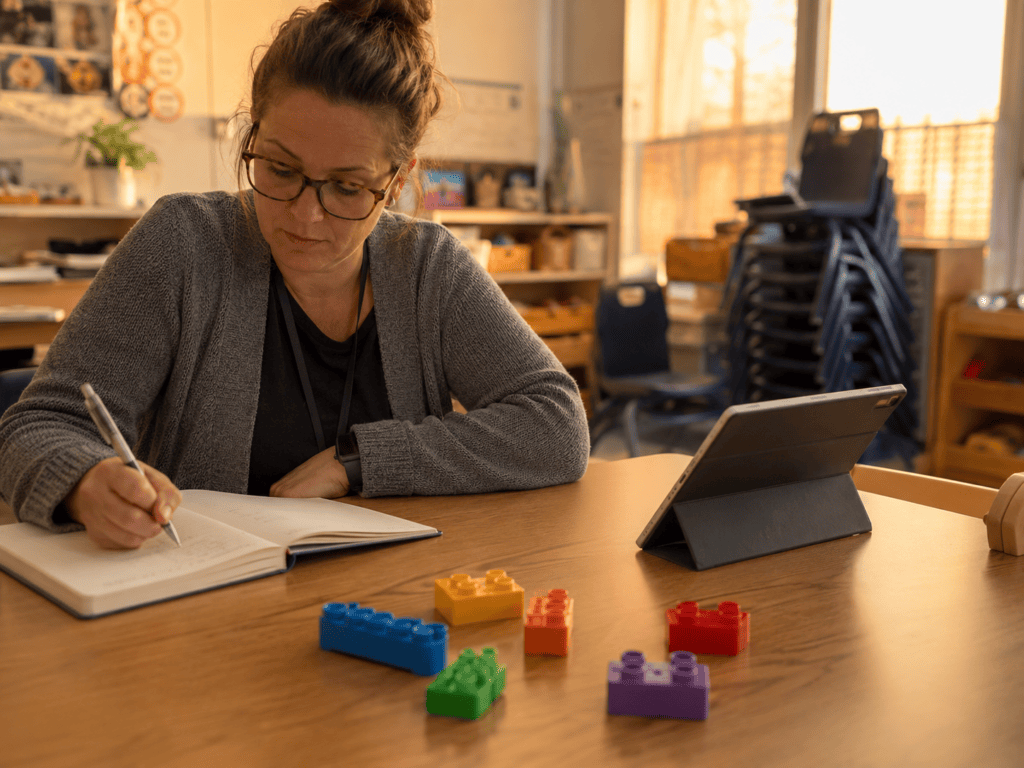
It's 5:40pm. The room is packed down, the last family has gone, and you're in front of a laptop trying to remember exactly what a four-year-old said when he finally worked out how to finish the pattern. Of course it mattered. In fact, it was real thinking, not lucky guessing. But the words have gone, and the observation is still due tomorrow.
Of course, every educator knows that feeling. Documenting play-based learning isn't the problem, because the evidence matters and writing it well is part of the craft. Instead, the problem is timing. First we plan in one place, then we teach in another, and finally we reconstruct the evidence hours later from memory.
However, it gets far easier when the activity is designed to produce evidence while it runs, rather than after. That's the shift this guide is about: first choosing activities with a clear developmental target, then knowing what to watch for before you start, and finally capturing it in the moment.
Six Bricks works well here for a practical reason. Because an activity takes two to five minutes, uses six DUPLO®-style bricks, and targets one named skill, you already know what you're looking for before a single brick is touched.
Quick Overview
- Who is this for? Early childhood educators, Pre-K and K–2 teachers, centre directors, and inclusion support educators in early learning centres.
- What will you learn? How to plan short activities that generate their own documentation, what separates a thin observation note from a strong one, and how to decide what's worth recording each week.
- Key takeaway: Documentation gets shorter and stronger when you decide what you're looking for before the activity starts — not after.
What does documenting play-based learning actually mean?
Documenting play-based learning means recording what a child did, said, or worked through during play, and then connecting it to a developmental skill or learning outcome. In short, it's evidence of thinking rather than a diary of activities.
The distinction matters. For example, "The children enjoyed building with bricks" describes a session. By contrast, "Mia rebuilt her tower three times after it fell, changing the base each attempt" describes a child holding a goal in mind while adjusting her approach — cognitive flexibility, visible and dated.
Overall, most documentation systems ask for some combination of the same four things:
- What happened — the observable action, in plain language
- What it shows — the skill or capability underneath it
- Where it links — the framework, outcome, or goal it connects to
- What's next — the follow-up that extends the learning
The first is easy to write, but also easy to forget. Meanwhile, the middle two are where educators lose the most time, because they're written retrospectively, from memory, under pressure.
Why documentation feels harder than it should
Actually, documentation feels heavy for three structural reasons — and none of them are about educator skill.
- Planning and evidence live in separate places. For example, the program is written on Friday, while the observation is written the following Wednesday. As a result, nothing connects them except recall.
- Open-ended play generates too much to record. When an activity has no defined target, everything looks potentially significant, so nothing gets prioritised.
- Framework language is a translation job. Educators watch a child in plain English, then translate into outcome language afterwards. Unfortunately, that translation is the slow part.
Fortunately, short and structured activities solve more of this than they get credit for. When an activity has one named focus — working memory, inhibitory control, cognitive flexibility — the field of what to notice narrows dramatically. As a result, you stop watching everything and start watching one thing.
This is also why structure matters more than materials. After all, anyone can hand children bricks. Ultimately, the difference between play and a documented developmental activity is knowing what the activity is for before it begins.
Thin notes vs. strong notes: what to write down
Often, the gap between a note that sits in a folder and a note that carries real evidence is about 15 extra words. For instance, here's the same moment recorded two ways.
| Element | Thin note | Stronger note |
|---|---|---|
| The action | "Built a tower with bricks." | "Copied a six-brick pattern from memory after a five-second look." |
| The child's words | Not recorded | "He said, 'No wait — blue goes under.'" |
| The skill shown | "Good fine motor skills." | "Held the sequence in mind while placing — working memory." |
| The struggle | Omitted | "Needed two attempts; self-corrected without prompting." |
| What's next | "Continue with blocks." | "Extend to eight bricks; add a distraction step." |
Fortunately, three habits close that gap:
- Write the child's exact words. Indeed, a five-word quote is worth a paragraph of description.
- Record the correction, not just the success. After all, self-correction is stronger evidence of executive function than getting it right first time.
- Note what you'd change next time. As a result, it turns an observation into a plan without a second writing session.
A five-minute activity that documents itself
Here's how this looks in practice, in a Pre-K room, mid-morning, just before outdoor play.
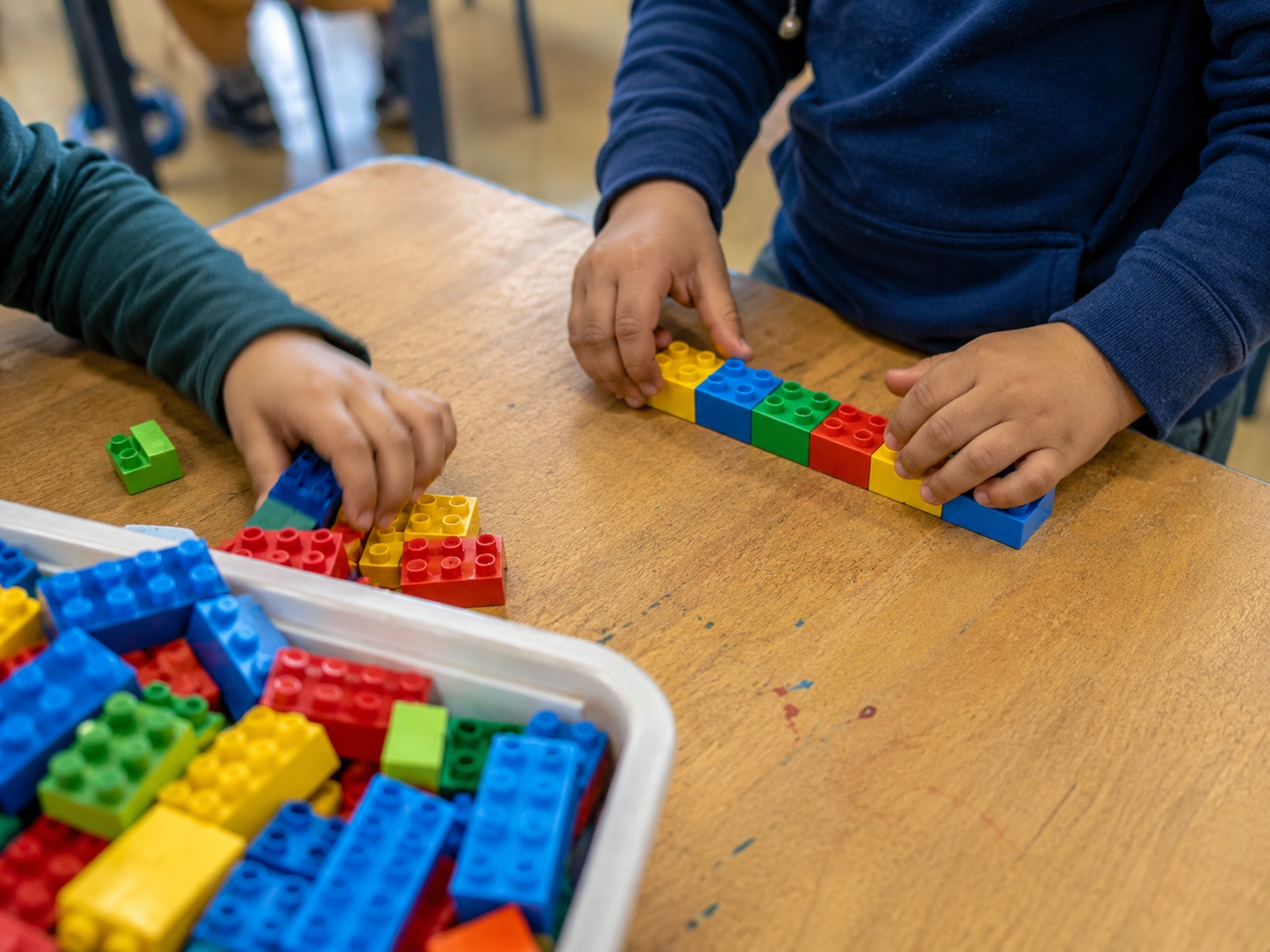
First, the educator sits with four children and six bricks each — yellow, green, light blue, dark blue, red, orange. Her focus for the week is working memory. Therefore, she has already decided what she'll be watching for: whether children can hold a sequence in mind while their hands are busy.
The activity, step by step
- First, she builds a four-brick tower behind a small screen, then reveals it for five seconds.
- Next, children rebuild it from memory, without talking during the build.
- Then she reveals hers again, so children can compare and fix their own.
- After that, she repeats with five bricks, and finally with six.
- Altogether, it takes four minutes.
Meanwhile, she notes three things on a sticky pad as it happens: one child's exact words, one self-correction, and one child who needed the tower shown twice. That's three documented observations before the group has even lined up for the door.
The activity works for documentation because it has a visible outcome (the tower either matches or it doesn't), a single skill target, and a built-in error moment — the comparison step — where thinking becomes observable. In addition, Six Bricks includes more than 100 activities structured this way across five developmental domains: cognitive, social, emotional, physical, and language.
Adapting it without losing the evidence
For children who are low-verbal, or who find group attention demanding, the same activity documents just as well. For instance, use point-to-match instead of rebuild, or work in a pair rather than a group of four. Either way, what you're recording — held the sequence, noticed the mismatch, adjusted — doesn't depend on speech.
How to choose what to document this week
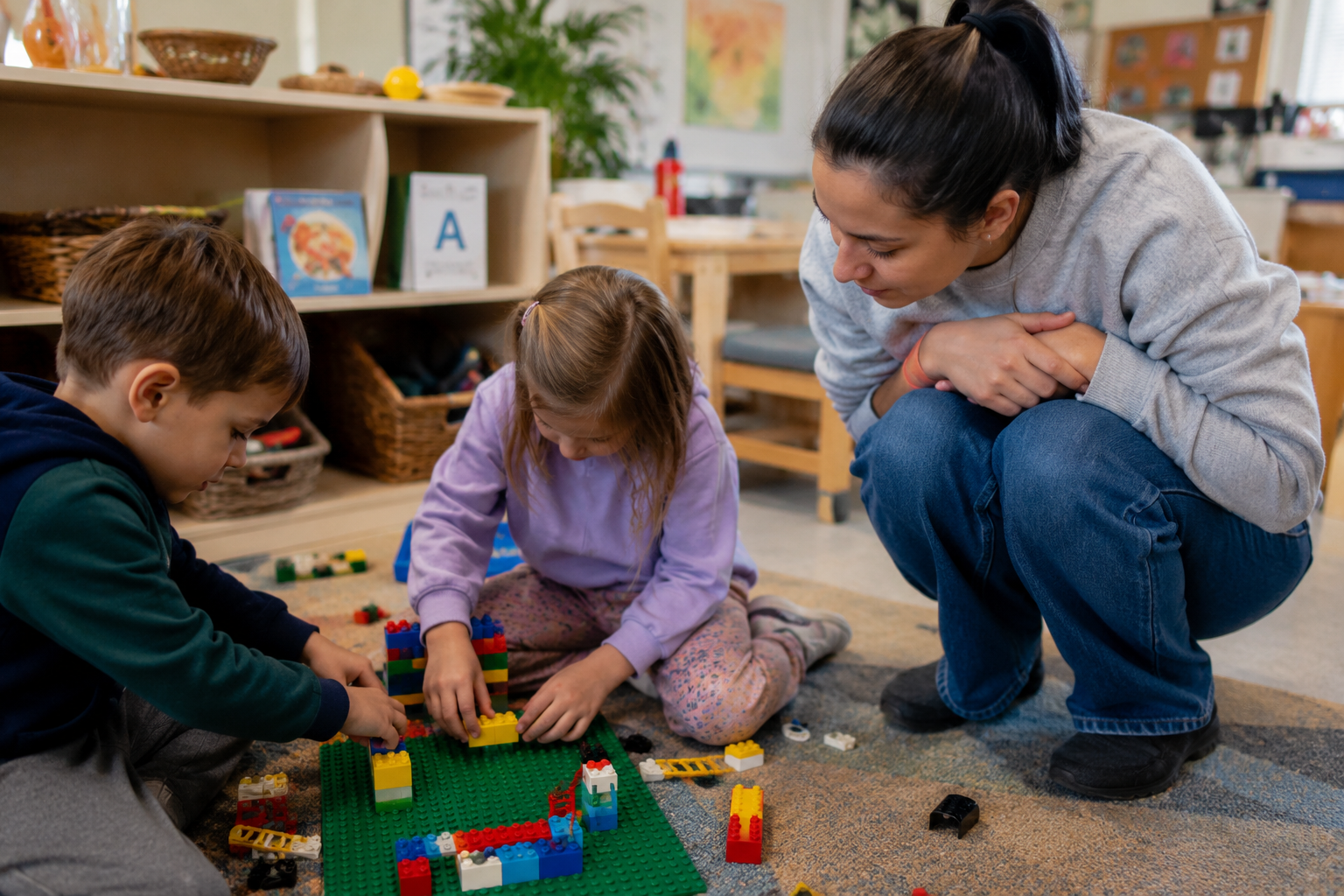
Of course, you can't document everything, and trying to is what makes it exhausting. Instead, use a simple decision sequence.
- Start with the child, not the activity. Who has the thinnest evidence file right now? Then plan around them.
- Pick one executive function focus per week. Working memory, inhibitory control, cognitive flexibility, attention control, emotional regulation, or planning and organisation. Ultimately, choose one rather than four.
- Choose the shortest activity that shows it. After all, a two-minute activity you actually run beats a twenty-minute one you postpone.
- Decide your evidence in advance. In other words, write the sentence stem before the session: "I'm watching for whether ___ can ___ without ___."
- Cap it at three observations. Besides, three strong notes beat twelve fragments.
This is also where spatial and sequencing work earns its place. Notably, research indicates that spatial ability at age four is one of the strongest predictors of mathematical ability at age eight. Because of that, pattern, position, and sequence activities are some of the highest-value things you can document in the year before school. For exactly that reason, the B-line mat in our Six Bricks educational resources is built around spatial and sequential work.
Plan and document in the same step
Ultimately, the most useful change isn't writing observations faster. Rather, it's not writing the plan and the evidence separately in the first place.
That's what we built the Six Bricks Generator Tool to do. First, you answer seven quick questions — executive function focus, age band, setting, group size, session length, neurodiversity support, and what you need in the download. Altogether, it takes about a minute. Then you get three real Six Bricks activities matched to your group, with framework links, observation prompts, and evidence examples already written into the plan.
Above all, the observation prompts are the part that changes the afternoon. They tell you what to watch for before the activity runs, so you're capturing in the moment rather than reconstructing at the end of the day. In addition, you can add your centre name, educator name, session date, and child or group name, so the plan downloads ready to file rather than ready to retype.
If you want to go deeper than a single session plan, our online courses for educators cover the methodology properly, while the Six Bricks group kits give you the physical materials for a full room.
Key Takeaways
- Documentation gets easier when you decide what you're looking for before the activity starts, not after it ends.
- One named skill focus per week narrows what you need to watch, and therefore shortens what you need to write.
- A child's exact words and self-corrections are the strongest evidence you can capture, but also the easiest to lose.
- Short activities of two to five minutes generate more usable evidence than long open-ended sessions, because the outcome is visible.
- In short, three strong observations a week beat twelve fragments.
- Above all, planning tools that include observation prompts remove the retrospective translation step entirely.
FAQ
What is documentation in early childhood education?
How do I document play-based learning without spending hours after work?
How much detail does a learning observation actually need?
Can a five-minute activity produce enough evidence to document?
How do I document learning for children who don't speak much during play?
Is the Six Bricks Generator Tool free to use?
Six Bricks Learning is a division of Focus Learning Group PTY LTD, led by Dr Denise Meyerson, and brings over 34 years of experience in education and playful learning. Above all, we create research-aligned resources that help educators turn short, structured play into visible developmental outcomes.
Give your room something worth documenting
Group kits put the bricks, grids, and emotion bricks in every educator's hands, while our online courses show you how to run short activities with a clear developmental target. In addition, both are approved for Queensland Uplift funding.
Small and large kits · NESA-accredited professional development
Want to try the planning side first? Answer seven quick questions and get three Six Bricks activities matched to your group, with observation prompts and evidence examples already written in.
Free to use · No sign-up to see your plan