
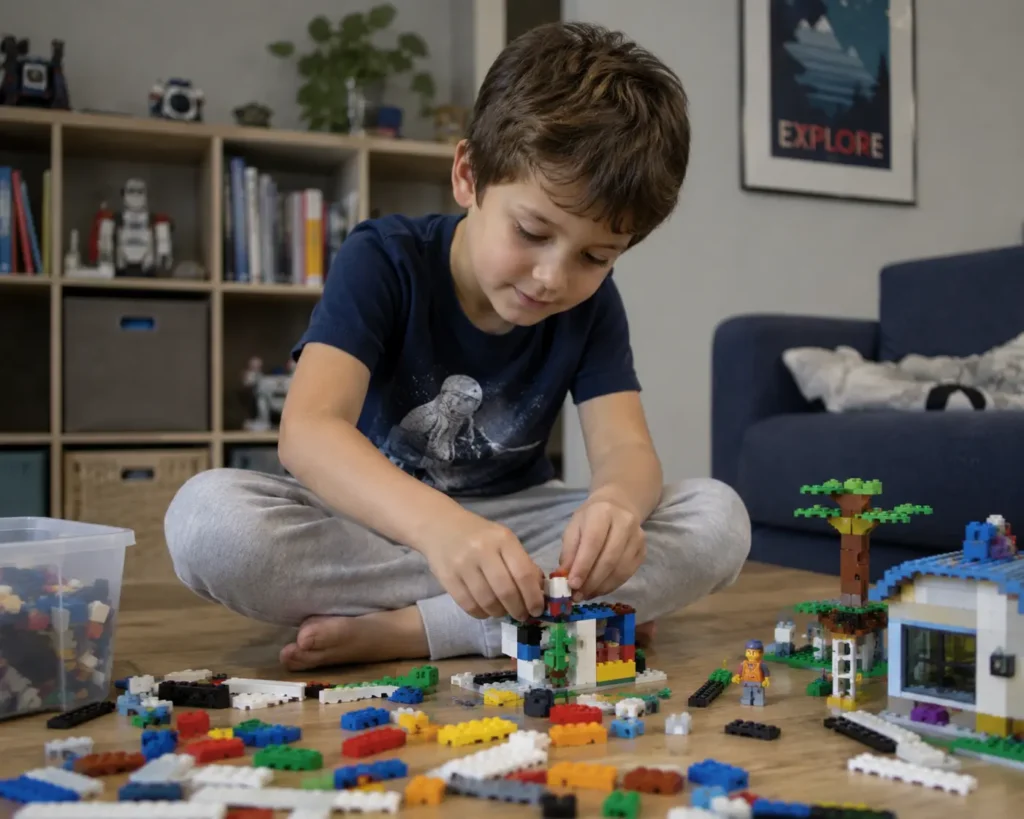
In many classrooms and homes today, screens are part of daily learning. From interactive whiteboards to tablets and online platforms, digital tools have expanded access and flexibility. But alongside these benefits, educators and parents are noticing something else: shorter attention spans, increased fatigue, and children finding it harder to stay engaged in sustained, focused tasks.
This shift has sparked an important question: what kind of learning experiences do children need most right now?
Research in child development continues to point to something surprisingly simple — hands-on, physical interaction remains essential for deep learning. Children don’t just think with their minds; they think with their bodies, through movement, touch, and interaction.
This is where structured, play-based approaches like Six Bricks become especially relevant. By combining short, multi-sensory activities with intentional learning goals, Six Bricks offers a practical way to rebalance modern learning environments — without rejecting the benefits of digital tools.
In this blog, we’ll explore why hands-on learning matters more than ever, what the science says, and how educators and parents can use simple brick-based routines to support attention, memory, and engagement.
Quick Overview
- Who is this for? Educators, parents, and school leaders navigating digital-heavy learning environments
- What will you learn? Why hands-on learning supports attention and memory in today’s context
- Key outcome: Practical ways to integrate Six Bricks into modern classrooms and homes
What Is Hands-On Learning — and Why Does It Still Matter?
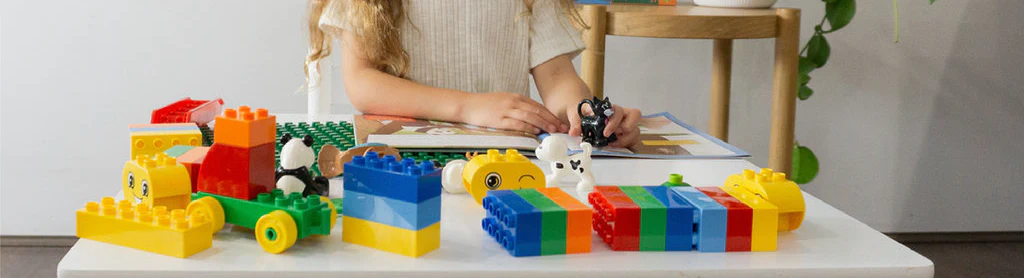
Hands-on learning is the process of understanding concepts through physical interaction, manipulation, and experience. It is grounded in the idea that children learn best when they actively engage with materials rather than passively receive information.
This idea is strongly supported by embodied cognition, which suggests that thinking is deeply connected to physical experience. When children move, build, and manipulate objects, they create stronger mental connections.
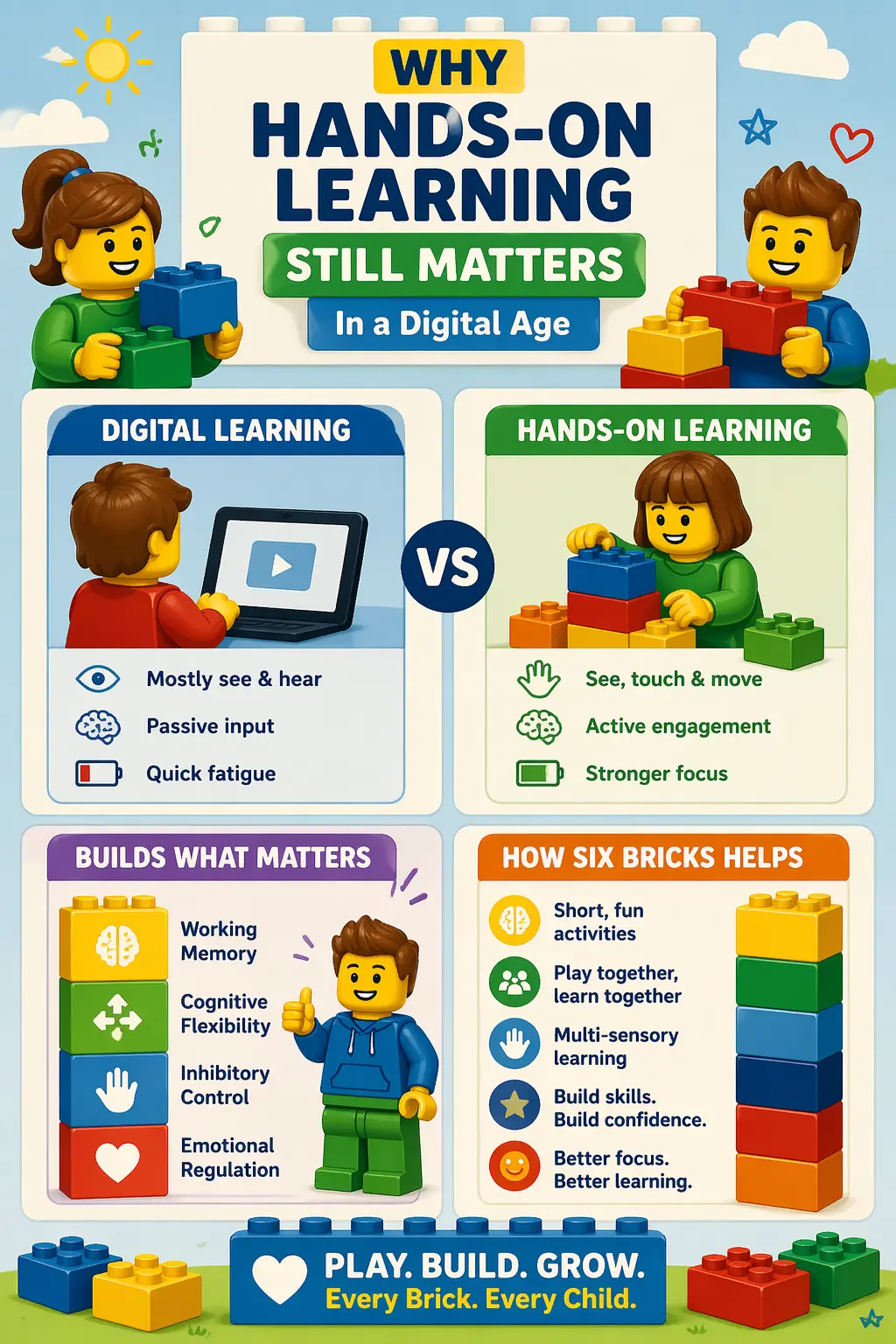
In a digital-first environment, this matters even more. Screens often prioritise visual and auditory input, but they rarely engage touch or movement in meaningful ways. As a result, learning can become less anchored and harder to retain.
Six Bricks addresses this gap by offering:
- Tactile engagement through physical bricks
- Structured routines that build consistency
- Short, repeatable activities that support attention
The result is not a rejection of technology — but a balance, where physical learning strengthens what digital tools alone cannot provide.
Why Attention and Working Memory Are Under Pressure Today
Working memory is the brain’s ability to hold and use information in real time — and it is essential for learning.
In today’s fast-paced environments, children are often switching between tasks, inputs, and platforms. This constant shifting can place strain on:
- Working memory: Holding and processing information
- Inhibitory control: Managing distractions
- Cognitive flexibility: Switching between tasks effectively
Together, these form executive function — the brain’s management system. Developmental research consistently shows that executive function skills are strong predictors of school readiness, highly trainable through structured activities, and best developed through active, engaging experiences.
Six Bricks activities are intentionally designed to target these skills. For example:
- Remembering a sequence of colours → working memory
- Following changing instructions → cognitive flexibility
- Waiting for a turn → inhibitory control
In a world where attention is constantly divided, these short, focused activities help children rebuild the mental habits needed for sustained learning.
The Role of Multi-Sensory Learning in Modern Classrooms
Multi-sensory learning engages more than one sense at a time — typically touch, sight, and movement — to strengthen understanding and memory.
Evidence from educational research suggests that when multiple senses are engaged, attention improves, memory encoding becomes stronger, and learning becomes more meaningful.
This is particularly important for:
- Younger children still developing foundational skills
- Neurodiverse learners who benefit from varied input
- Children who need movement to stay engaged
Six Bricks is inherently multi-sensory: children see colour and structure, touch and manipulate bricks, and often speak or listen during guided activities.
This combination aligns closely with the LEGO Foundation’s five characteristics of playful learning — joyful, meaningful, actively engaging, iterative, and socially interactive. In practice, this means learning becomes more memorable, more inclusive, and more enjoyable.
How Six Bricks Supports Learning in a Digital World
Six Bricks works best not as a replacement for digital tools, but as a powerful complement to them.
In modern classrooms, it can be used to:
- Reset attention between screen-based tasks
- Reinforce concepts physically after digital instruction
- Build routine and predictability in fast-moving schedules
Classroom Example
Imagine a Year 1 classroom transitioning from a tablet-based literacy activity. Children begin to lose focus. Some are distracted. Others are rushing.
The teacher pauses and introduces a 3-minute Six Bricks activity:
- “Build the sequence: red, blue, yellow.”
- “Now close your eyes — can you rebuild it from memory?”
- “Now change the order — what’s different?”
In just a few minutes, children reset their attention, working memory is activated, and the classroom energy shifts. After this, students return to their digital task more focused and ready to engage.
This kind of short, structured routine is one of the most effective ways to support brain readiness throughout the day.
Why Brick-Based Play Supports Inclusive Learning
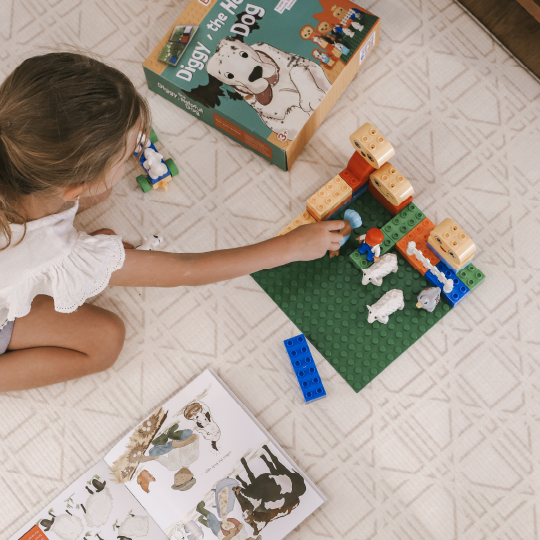
Hands-on, structured play creates multiple entry points for participation. Not all children learn in the same way. Some benefit from visual input, some from movement, some from repetition, and others from social interaction.
Six Bricks naturally supports this diversity because:
- Activities can be adapted in complexity
- Participation can be verbal or non-verbal
- Tasks can be individual, paired, or group-based
This aligns with Vygotsky’s Zone of Proximal Development, where children learn best when tasks are just beyond their current ability — with support.
Importantly, Six Bricks is not designed for a single “type” of learner. It is predictable (supporting regulation), flexible (supporting differentiation), and engaging (supporting motivation). This makes it especially valuable in classrooms where needs are varied and dynamic.
Key Takeaways
- Hands-on learning remains essential in a digital-first world
- Working memory and attention are under increased pressure — but can be strengthened
- Multi-sensory experiences improve engagement and retention
- Six Bricks provides short, structured routines that support executive function
- Brick-based play creates inclusive, flexible learning opportunities
FAQ
How does hands-on learning help children focus better?
Hands-on learning engages multiple senses, which helps anchor attention. When children actively manipulate materials, they are more likely to stay engaged and process information deeply.
Can Six Bricks be used alongside digital learning tools?
Yes. Six Bricks works best as a complement to digital tools, helping reset attention and reinforce concepts through physical interaction.
How often should Six Bricks activities be used in a classroom?
Activities can be used multiple times a day, often as short 2–5 minute routines. Consistency is more important than duration.
Is hands-on learning suitable for older primary students?
Absolutely. Research shows that spatial and tactile learning remain important beyond early childhood. Older students benefit from structured, meaningful manipulation just as younger children do.
About the Author
Written by the Six Bricks Learning Content Team. We create research-aligned, practical resources that support educators and caregivers in building confident, capable learners through play.
Bring Balance Back to Learning
Ready to bring balance back into your learning environment? Explore our Six Bricks Group Kits and discover how short, structured play routines can support attention, memory, and engagement in your classroom or home.
Explore Six Bricks Group Kits