
Young children build powerful language and literacy skills not by drilling with flashcards, but by playing, talking, building, and exploring. That’s why the best learning tools are often right at your fingertips—blocks, music, stories, and even a basket of toys. These interactive activities not only improve vocabulary, but also foster communication development, phonological awareness, and even fine motor skills.
When learning feels like play, children remember it. And when it feels meaningful, they use it.
Why Early Language and Literacy Development Begins with Play
Language development in early childhood sets the stage for school success. According to the American Academy of Pediatrics, language-rich interactions and responsive communication build both expressive and receptive language.
But flashcards and rote drills can’t match what happens when kids:
- Build semantic networks through story play
- Practice word recognition during shared reading
- Explore phonemic awareness by clapping out syllables
- Strengthen auditory processing skills with song and rhythm
- Boost cognitive development with silly sentence games or I Spy riddles
Whether you’re indoors or outside on a nature walk, your home is full of learning potential.
1. Vocabulary-Building Activities Without Flashcards
Rather than drilling sight words, try vocabulary games that build word exposure in real-time conversations. Here are our favorite ways to boost vocabulary while having fun:
🧱 “Color Clues” Brick Game
Assign each brick color a descriptive clue:
- Red = Emotions
- Blue = Farm animals
- Yellow = Sight words (like “the,” “go,” “it”)
Build a tower by giving descriptive clues, encouraging your child to guess the word. It’s a fun twist on Vocabulary Bingo and supports visual recognition and word knowledge.
➡️ Try it using the Let’s Get Started Deck — 24 creative literacy tools designed for preschoolers.
🧺 “Basket of Sounds” for Phonological Awareness
Fill a basket with recycled materials and common objects: plastic food, index cards with words, or toys. Invite your child to:
- Label the object (naming for spoken language)
- Clap the syllables (phonemic awareness)
- Act out a verb for it (expressive language skills)
Bonus: Add a bean bag to create a “Sound Toss”—say a word, toss the bean bag to the matching item.

2. Encourage Storytelling and Narrative Structure Through Play
Building stories helps children develop sentence structure, word connections, and critical thinking. Here’s how to use daily moments for storytelling magic:
📖 Build-a-Book Adventures
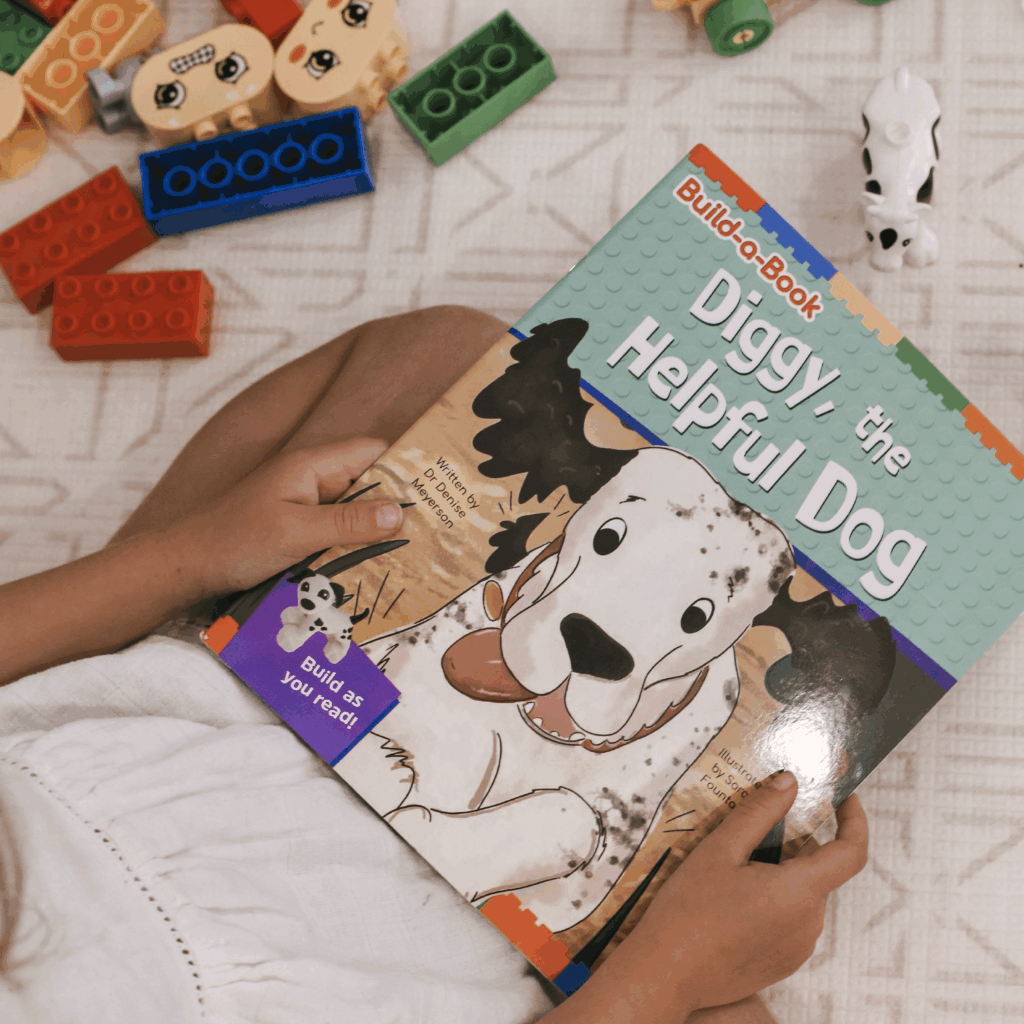
Use a Build-a-Book kit like Cracker, the Lonely Crocodile or Diggy, the Helpful Dog to build scenes from the story. Then, ask:
- “What happens next?”
- “What does Cracker feel?” (Building empathy and communication skills)
- “How does Diggy solve the problem?” (Develops narrative structure)
You can also invent your own endings using DIY Ocean Activities or holiday themes like Christmas Art Projects or Leprechaun Traps to inspire seasonal storytelling.
3. Pre-Reading Skills Through Play-Based Literacy Tools
Children don’t just need to learn letters—they need to understand how sounds, symbols, and meaning work together. These activities target letter-sound correspondences, sight word games, and early reading comprehension:
🔤 Magnetic Letter Treasure Hunt
Hide magnetic letters around the room. Use a shopping list of sight words or sentence strips:
- “Find the letters to build the word cat”
- “Spell the word you hear”
It becomes a treasure hunt that boosts letter recognition, visual communication, and reading fluency.
🎨 Word Families With Arts and Crafts
Use arts and crafts time to build word families: paint a tree with a trunk that says “-at” and leaves for “cat,” “hat,” and “bat.” Reinforces word maps and vocab building through visual aids. Try it with sensory bins or discovery bottles for added engagement!
4. Make It Musical and Movement-Based
Music, dance, and games integrate language-rich interactions with auditory learning and fine motor development:
- Play “20 Questions” with toys and household items
- Sing Word of the Day songs with a tune
- Create Music Instrument DIYs from rubber rope, beans, or bottles
These methods are supported by experts like Mary Muhs of Rasmussen University School of Education, who emphasizes movement and creativity for learning retention.
Frequently Asked Questions (FAQ)
What’s the difference between expressive and receptive language?
Expressive language refers to the words children say, while receptive language refers to what they understand. Balanced development in both supports reading comprehension and communication skills.
How can I support language delays at home?
Use labeling games, shared reading, and playful index card prompts. Speech pathologists recommend daily repetition and rhythm-based routines, including Read Aloud Sessions and singing with your child.
Are online tools like ABC Reading Eggs or worksheets helpful?
Yes, in moderation. Blending online lessons with real-life preschool learning activities, like Kitchen Science Experiments or STEM Activities, helps reinforce concepts across settings.
What if my child isn’t interested in letters yet?
Focus on environmental sounds, pretend play, and spoken language games first. This strengthens the foundation for later literacy—no need to rush into Crossword Puzzles or word games just yet.
Recommended Tools to Try
- Let’s Get Started Deck
Includes interactive Vocabulary Activities and hands-on phonological awareness games - Diggy, the Helpful Dog
Supports critical thinking, problem-solving, and word families - Cracker, the Lonely Crocodile
Reinforces story structure, empathy, and expressive language - Six Bricks for Autistic Children
Adaptable for diverse communication development needs
About the Author
This post was created by the Six Bricks Learning Content Team, made up of experienced early childhood educators, speech development specialists, and play-based learning advocates. With backgrounds in curriculum design and early years pedagogy, our mission is to help every child thrive through playful learning. Our work is grounded in research, guided by practice, and inspired by the joy of discovery.